John Piper seems to think so. Never thought I would see the day. First he says "smartass" at the DGM national conference and now he has hip hop in his church, what next? I love it. Check it out:
(HT: Joshua Harris)

Tuesday, October 31, 2006
Happy Halloween
If I worked at one of those churches where we had the cheesy marquee out front, today the marquee would read:
"This house is possessed by the Holy Ghost"
(HT: Crummy Church Signs)
"This house is possessed by the Holy Ghost"
(HT: Crummy Church Signs)

Can We Rock The Gospel? - Chapter 2
The author’s begin chapter two by tracing the beginnings of current western pop music from the early rhythms of African people. I am no music historian, but from what the little I do know, rock music is the grandchild of blues, which is traditionally one of the primary methods of expression for the oppressed black man. They then make the claim that one of the main motivations and themes of blues music was illicit sex. This claim or may or may not be true, I am no blues historian, but for sure this is something that is new information to me. They make this point only to state that all cultural musical forms are fundamentally flawed in that they are performed and created by sinful people. I have no problem with this.
They then go on to trace rock and roll from Bill Haley and the Comets, to Elvis, then the British Invasion of the Beatles, to the Rolling Stones, Led Zeppelin, Black Sabbath, Deep Purple, etc. I’ll spare you all the history, but the authors trace all the different bands that were and are popular up to the current day.
In chapter two they make no real judgments about these bands and artists other than to highlight that a majority of them embraced a lifestyle that was sub-Christian. To this I would agree but also say, so what? What do we expect from people who are not Christians, to act like them? Couldn’t we say the same is true of non-Christian doctors, businessmen, garbage men, and another of profession that you can think of? I believe that what they might say is that your typical American profession (doctor or lawyer or whatever) does not have nearly the influence culturally that our rock icons do. I would agree, but I am still waiting to hear why a certain lifestyle of a performer makes a musical arrangement of certain types of instruments, sounds and rhythms inherently and objectively bad for the church. Does the fact that Mozart’s lifestyle was immoral or sub-Christian make me playing one of his piano compositions wrong? I guess I have 8 chapters left to get an answer, but I must admit that I am skeptical that a real one exists.
In anticipating their argument that we should not use rock music in the church due to the fact that it comes with so much negative cultural baggage, I would like to ask this question: Would people from a non-western culture that are oblivious to the history of rock music be free to use it in the church?
Again, what the heck is rock music? I seems that if we are going to say “it” is really that harmful then we should be able to define what “it” is.
No answer on that one after chapter two.
They then go on to trace rock and roll from Bill Haley and the Comets, to Elvis, then the British Invasion of the Beatles, to the Rolling Stones, Led Zeppelin, Black Sabbath, Deep Purple, etc. I’ll spare you all the history, but the authors trace all the different bands that were and are popular up to the current day.
In chapter two they make no real judgments about these bands and artists other than to highlight that a majority of them embraced a lifestyle that was sub-Christian. To this I would agree but also say, so what? What do we expect from people who are not Christians, to act like them? Couldn’t we say the same is true of non-Christian doctors, businessmen, garbage men, and another of profession that you can think of? I believe that what they might say is that your typical American profession (doctor or lawyer or whatever) does not have nearly the influence culturally that our rock icons do. I would agree, but I am still waiting to hear why a certain lifestyle of a performer makes a musical arrangement of certain types of instruments, sounds and rhythms inherently and objectively bad for the church. Does the fact that Mozart’s lifestyle was immoral or sub-Christian make me playing one of his piano compositions wrong? I guess I have 8 chapters left to get an answer, but I must admit that I am skeptical that a real one exists.
In anticipating their argument that we should not use rock music in the church due to the fact that it comes with so much negative cultural baggage, I would like to ask this question: Would people from a non-western culture that are oblivious to the history of rock music be free to use it in the church?
Again, what the heck is rock music? I seems that if we are going to say “it” is really that harmful then we should be able to define what “it” is.
No answer on that one after chapter two.
Monday, October 30, 2006
Can We Rock the Gospel? - Chapter 1
When I saw Tim Challies' post on the book called, "Can we Rock the Gospel?" I knew that I had to check it out. It came in the mail today. I plan on blogging through each chapter and give a summary and reflections.
They start the chapter by highlighting this statement, "The time has come to take a calm, balanced, thorough, and Biblical look at what me might call "entertainment evangelism". This statement led me to ask my first question, "Entertaining for who". Do all people find "rock" music entertaining? I would say certainly not. I personally enjoy many forms of rock music, but definitely not all. What about the quality of the music? Should this not be a big part of the question no matter the genre? If the authors are affirming the continued use of hymns and organs or banjos or whatever (they have not said this yet), is it not possible that some people could also find this "entertaining" or are these musical forms inherently less entertaining? What is meant by entertainment and how do you know when you are being entertained? I am getting ahead of myself here...
In chapter one, the authors trace the path of music in the church in the last twenty years or so. They start in the early eighties when "rock" music began to emerge in a few churches here and there trace it to today where it is common place in most local churches. They make a strong claim that the influx of "rock" music (which they have yet to define) has much to do with the church growth movement that spread rapidly in the late eighties and nineties.
They then print many testimonies of people who for a variety of reasons have major problems with rock music in church. Here is one example from page 23, "At...Chapel the worship was awful. It was like pure noise. The drums were so loud that I couldn't hear the praise team sing. And the bass was really loud too. It was like going to a rock concert. And the songs they picked were not worshipful to say the least. They troubled my spirit". Sounds like this guy suffered from a bad sound engineer and pour worship leadership, but this has nothing to do with rock being wrong in and of itself.
I have to say from the outset I am having a hard time figuring out how the authors believe that a purely subjective and preference laden statement as found above does anything but take away from any argument that rock music is objectively wrong for the church. The problem is that I could also find just as many testimonies from people who have really strong feelings against any form of music that you could come up with to use in the church.
The author's make their feelings clear on page 34, where they say, "The author's make no secret of the fact that we count ourselves among those who are offended by rock music in God's service and are truly perplexed that so many other Christians go to such great lengths to make use of it in both worship and evangelism.
They then go on to warn that there are many people in our churches who are deeply hurt by the changing trends of music. They imply that leaders need to repent of placing this "stumbling block in the way of so many believers". Questions: So we remove rock, then do what? Go back to what form of music? Also, what about all those people who love rock music, would they not also be offended if we removed it all? From the beginning of this book I am finding that there are many many questions left unanswered. I am troubled that no definition of "rock" music is given, thus I feel they are critiquing something that has no real boundaries or distinctives. I am starting to think this project of blogging through this book might be a grand waste of time as I am very unimpressed (not because I disagree) with the approach the authors have taken in this first chapter, but since I am now a worship pastor I think this will be a good exercise for me.
They end the chapter by listing the four reasons why they believe this book needs to be read and understood.
1. Widespread ignorance in the church about rock music and the problems it has caused.
2. Biblical illiteracy on the subject of worship.
3. New and controversial teachings about the subject of rock music are taking hold in the church.
4. Incorrect assumptions about those who object to rock.
I would group myself in those who probably have "incorrect assumptions" about those who object to rock. I hope the authors can give some more solid arguments in the rest of the book beyond mere subjectivism. The authors claim they will give biblical arguments in the remaining chapters. I look forward to it what they will have to say.
(BTW - if you or anyone you know honestly believes that rock music is objectively wrong I would love to interact with them here and read what they have to say.)
They start the chapter by highlighting this statement, "The time has come to take a calm, balanced, thorough, and Biblical look at what me might call "entertainment evangelism". This statement led me to ask my first question, "Entertaining for who". Do all people find "rock" music entertaining? I would say certainly not. I personally enjoy many forms of rock music, but definitely not all. What about the quality of the music? Should this not be a big part of the question no matter the genre? If the authors are affirming the continued use of hymns and organs or banjos or whatever (they have not said this yet), is it not possible that some people could also find this "entertaining" or are these musical forms inherently less entertaining? What is meant by entertainment and how do you know when you are being entertained? I am getting ahead of myself here...
In chapter one, the authors trace the path of music in the church in the last twenty years or so. They start in the early eighties when "rock" music began to emerge in a few churches here and there trace it to today where it is common place in most local churches. They make a strong claim that the influx of "rock" music (which they have yet to define) has much to do with the church growth movement that spread rapidly in the late eighties and nineties.
They then print many testimonies of people who for a variety of reasons have major problems with rock music in church. Here is one example from page 23, "At...Chapel the worship was awful. It was like pure noise. The drums were so loud that I couldn't hear the praise team sing. And the bass was really loud too. It was like going to a rock concert. And the songs they picked were not worshipful to say the least. They troubled my spirit". Sounds like this guy suffered from a bad sound engineer and pour worship leadership, but this has nothing to do with rock being wrong in and of itself.
I have to say from the outset I am having a hard time figuring out how the authors believe that a purely subjective and preference laden statement as found above does anything but take away from any argument that rock music is objectively wrong for the church. The problem is that I could also find just as many testimonies from people who have really strong feelings against any form of music that you could come up with to use in the church.
The author's make their feelings clear on page 34, where they say, "The author's make no secret of the fact that we count ourselves among those who are offended by rock music in God's service and are truly perplexed that so many other Christians go to such great lengths to make use of it in both worship and evangelism.
They then go on to warn that there are many people in our churches who are deeply hurt by the changing trends of music. They imply that leaders need to repent of placing this "stumbling block in the way of so many believers". Questions: So we remove rock, then do what? Go back to what form of music? Also, what about all those people who love rock music, would they not also be offended if we removed it all? From the beginning of this book I am finding that there are many many questions left unanswered. I am troubled that no definition of "rock" music is given, thus I feel they are critiquing something that has no real boundaries or distinctives. I am starting to think this project of blogging through this book might be a grand waste of time as I am very unimpressed (not because I disagree) with the approach the authors have taken in this first chapter, but since I am now a worship pastor I think this will be a good exercise for me.
They end the chapter by listing the four reasons why they believe this book needs to be read and understood.
1. Widespread ignorance in the church about rock music and the problems it has caused.
2. Biblical illiteracy on the subject of worship.
3. New and controversial teachings about the subject of rock music are taking hold in the church.
4. Incorrect assumptions about those who object to rock.
I would group myself in those who probably have "incorrect assumptions" about those who object to rock. I hope the authors can give some more solid arguments in the rest of the book beyond mere subjectivism. The authors claim they will give biblical arguments in the remaining chapters. I look forward to it what they will have to say.
(BTW - if you or anyone you know honestly believes that rock music is objectively wrong I would love to interact with them here and read what they have to say.)
Accountability Relationships Usually Don't Work
Probably with the rise of men's movements like PromiseKeepers and others like it, the idea of an "accountability partner" has become common practice for many Christian men. Usually what this means is that you have a partner of mutual age and trust that you meet with one on one once a week or so and just check in about how life is going. Sometimes you agree to ask each other hard questions about sexual purity or some other specific sin issue. The intent of this relational structure is to provide a context for deterring sin since each person knows that there will be questions probing into conduct and thought life as it pertains to the past week. I have been in many one on one groups and small groups like this in the past and I would submit to you that they usually don't work. Why would I say this? Well, I believe it's due to the fact that there is no real consequence. Is your buddy going to shame you or rebuke you? Probably not. The other problem with this picture is that the person that you are accountability partners with is usually not someone who sees you day in and day out and really know the real you apart from your deep conversation had once a week over your warm frothy beverage at Starbucks. Thus you are the one who decides what you share and what you don't and there are most likely many sins that you are completely unaware of that need to be addressed. I know there is great benefit from bringing sin into the light (John 3:20-22) and we are called to "confess our sins, one to another" but I think there might be a better way. How is this to be done?
Instead of having a set aside time when you have someone ask you the "hard questions", find someone that really knows you and sees you day in and day out and set aside a time once a month or so to ask them one hard question: "Has there been anything you see in my life that needs adjustment or correction?" This way it gives the other person the freedom and permission to say whatever they see in your life and it takes away the ability of the confessor to "edit" his comments and only confess what he wants to confess and also helps you be aware of sins committed that you may be completely oblivious to. If you are married your spouse is perfect person to do this with, if you are single maybe it's a trusted co-worker or family member.
Of course there are secret sins that we commit that need time for specific confession with another person, but I believe that a consistent discipline of "checking in" with those who know you deeply and love you deeply may be a more effective way for increased sanctification in this life. It takes a great deal of humility to open yourself up to someone in this way, but I believe that in the end the blessing will be huge.
(Much of what I have said here is credited to things I have heard CJ Mahaney say over the past few years)
Instead of having a set aside time when you have someone ask you the "hard questions", find someone that really knows you and sees you day in and day out and set aside a time once a month or so to ask them one hard question: "Has there been anything you see in my life that needs adjustment or correction?" This way it gives the other person the freedom and permission to say whatever they see in your life and it takes away the ability of the confessor to "edit" his comments and only confess what he wants to confess and also helps you be aware of sins committed that you may be completely oblivious to. If you are married your spouse is perfect person to do this with, if you are single maybe it's a trusted co-worker or family member.
Of course there are secret sins that we commit that need time for specific confession with another person, but I believe that a consistent discipline of "checking in" with those who know you deeply and love you deeply may be a more effective way for increased sanctification in this life. It takes a great deal of humility to open yourself up to someone in this way, but I believe that in the end the blessing will be huge.
(Much of what I have said here is credited to things I have heard CJ Mahaney say over the past few years)
Tony Jones Wants To Hear From You
Tony Jones is currently writing a new book about the Emergent church. He wants to know what your questions are about it so he can attempt to answer them in the book. You can pose your question here.
Sunday, October 29, 2006
White and Nerdy
In keeping with the theme of video's on Sunday...
Just in case you haven't seen this yet, it's well worth the 3 minutes. Weird Al is a comic genius.
Imogen Heap - "Just for Now"
A very cool display of musicality and technology. Her CD doesn't sound this raw, its much more produced in a different and very cool way. If you don't have it, get it. It will blow you away. I am going to see her here in ABQ on Nov. 27th. After watching this video I am even more excited to see the show.
(HT: Francy Girl)
Saturday, October 28, 2006
Little Children
Some excerpts from Christianity Today's review of the movie "Little Children":
Ever wonder why moths flutter around bright lights at night and ask, "Don't they know that they'll burn themselves up?"See the trailer here.
And yet, so many of us play out the same sad drama. Restless with longing, we respond to dangerous temptations and indulge misguided passions. And then we—and sometimes our families—pay for it.
This metaphor comes to vivid life in Todd Field's riveting new film Little Children. Working from a screenplay that he and Tom Perrota adapted from Perrota's novel, Field paints a deeply disturbing picture of a cozy New England neighborhood in which everyone is pursuing happiness in misguided ways.
In fact, the movie will be too disturbing for some, because it is unflinchingly truthful about sins such as lust, sexual infidelity, and pedophilia. And while Perrota's story is profoundly moral, Field brings it to life in illustrations so explicit that some viewers may be led into temptation themselves.
Unfortunately, in his courage to expose the ugliness of sin with stark honesty, Field oversteps the bounds of propriety. He was smart to portray Brad and Sarah's sexual escapes as urgent, desperate grabs for happiness. But in doing so, he asks them to expose too much. For many this will be shocking, disrupting the flow of the film. For others, it will offer fuel for the fires of their own destructive fantasies.
That's a serious flaw in what is otherwise a profound work of art. Few films have been more truthful in showing us how our "secret sins"—those indiscretions we try to rationalize—are like weeds that take root, spread, and shatter our foundations.
Little Children does not conclude with a "happily ever after" ending. Field isn't interested in appeasing the audience's expectation for gushing confessions and teary-eyed reconciliation. That would be dishonest and unrealistic. Instead, he tells the truth. Our sinful appetites cannot be entirely eliminated in this lifetime, and thus none of us can boast. No relationships, vocations, or neighborhoods can solve our hunger for the sugar that will rot our teeth. And yet, if we allow the scorching glow of temptation to steer us away from our responsibilities, while we may experience fleeting jolts of happiness, we'll lose the opportunity for lasting fulfillment and joy.
Perhaps it's no coincidence that the film's tag line reads, "Let the little children come unto me."
The Holiness of God
From John Piper's Sermon found here:
Revival happens when we see God majestic in holiness, and when we see ourselves disobedient dust. Brokenness, repentance, unspeakable joy of forgiveness, a "taste for the magnificence of God," a hunger for his holiness—to see it more and to live it more: that's revival. And it comes from seeing God.
The word "holy" is the little boat in which we reach the world's end in the ocean of language. The possibilities of language to carry the meaning of God eventually run out and spill over the edge of the world into a vast unknown. "Holiness" carries us to the brink, and from there on the experience of God is beyond words.
1 Samuel 2:2, "There is none holy like the Lord, there is none besides thee." Isaiah 40:25, "To whom then will you compare me, that I should be like him? says the Holy One." Hosea 11:9, "I am God and not man, the Holy One in your midst." In the end God is holy in that he is God and not man. He is incomparable. His holiness is his utterly unique divine essence. It determines all that he is and does and is determined by no one. His holiness is what he is as God which no one else is or ever will be. Call it his majesty, his divinity, his greatness, his value as the pearl of great price. In the end language runs out. In the word "holy" we have sailed to the world's end in the utter silence of reverence and wonder and awe. There may yet be more to know of God, but that will be beyond words. "The Lord is in his holy temple; let all the earth keep silence before him" (Habakkuk 2:20).
You're Not that Hot Either
From Steve Croft's article, "Brother, You're Like a Six":
I once counseled a Christian brother in his dating relationship with a great woman. She was godly, caring, and bright. She was attractive, but not a supermodel. For weeks I listened to this brother agonize over his refusal to commit and propose to this woman. He said they were able to talk well about a lot of things, but there were a few topics he was interested in that she couldn't really engage with, and sometimes the conversation "dragged."
He also said that, while he found her basically attractive, there was one feature of hers that he "just pictured differently" on the woman he would marry. I would ask about her godliness and character and faith, and he said all those things were stellar (and he was right). Finally, he said, "I guess I'm looking for a 'ten'."
I could hold back no longer. Without really thinking, I responded, "You're looking for a 'ten'? But, brother, look at yourself. You're like a 'six.' If you ever find the woman you're looking for, and she has your attitude, what makes you think she would have you?"
Here's something else the world won't tell you. Even if you find your "perfect ten" — however you define "ten" — marriage is still hard. When you search for a spouse, you are looking for someone (a sinner, like you) who you will be serving God and living the Christian life with until Christ returns or one of you dies.
In that context, even a really good sense of humor will only get you so far. Physical attractiveness (as defined by the world) fades in 100 percent of people, including you. "Chemistry" as the world defines it ebbs and flows in any relationship. Your spouse can be as fun-loving as he or she can possibly be and there will still be many moments that aren't fun. Your spouse can have the best personality you've ever seen and he or she will still drive you absolutely batty sometimes if you live with him or her for the rest of your life. You can marry someone who appears to be an omni-competent genius, and there will still be times that neither of you knows what to do next. Knowing that is part of maturing as a person and as a believer, and believe it or not, it's part of what makes marriage wonderful and special.
As you seek someone with whom to serve God in marriage, build on something more than what might make for a few fun dates or an impressive "catch" in the world's eyes.
(HT: Pure Church)
An evaluation of rock music
Kevin Twit posts an interesting and helpful article entitled "Criteria for Judging Rock Music".
Friday, October 27, 2006
Is the world not as safe as it used to be?
My wife and I were discussing this today in the car and I would love your take on it. We were reminiscing about how when we were kids we used to go outside and play all day long and our parents literally had no idea where we were, we simply adhered to their wishes to "be home by dinner time". I grew up in smaller town Iowa in the 80's and my wife grew up in a suburb of the Twin Cities and we basically had similar experiences growing up. Now that I am a parent, the thought of letting my kids have the same approach to their free time is basically unthinkable.
Now the question: Is the world really much more dangerous or is this just our perception of it? My contention might be that due to the huge increase in media exposure we are a much more paranoid nation on the whole.
What do you think?
Now the question: Is the world really much more dangerous or is this just our perception of it? My contention might be that due to the huge increase in media exposure we are a much more paranoid nation on the whole.
What do you think?
Can We Rock The Gospel?
Tim Challies provides a helpful review of this new book that at first glance is very disturbing to me . I just ordered this book and I'm sure I'll have some reflections of my own in the near future.
Can I wear my swim trunks in church?
A few weeks back there was a lively discussion on this site concerning appropriate attire to wear in church. This article from Mark Driscoll gives an interesting perspective on the subject.
Thursday, October 26, 2006
Dangerous for the Whole Family
 If you are any sort of an artist or a Christian who has any inclination towards impacting culture please read this article. (Gatekeepers of Christian radio PLEASE read...)I couldn't say Amen any more loudly to it. Here is how he starts the article:
 If ever there were a time in which Christians had an influence in the media and arts, it is now. After the success of The Passion andThe Chronicles of Narnia, Hollywood has recognized there might be tangible ways to heal their declining box office receipts by catering to an untapped market. Two recent articles in the L.A. Times have uncovered this faith market. The first article announces Fox Faith, a brand underneath the banner of 20th Century Fox, which was launched to both re-brand some of their library (i.e. South Pacific and Garfield) under this label and also to create new films for this market. This article was followed up the next week with one heralding the family friendly Dove Foundation as a gatekeeper to the coveted audience base. Other studios such as Lion’s Gate, Sony Screen Gems, New Line and even the Weinstein Company are taking steps to go after this market.
So this is a critical time. It’s a “for such a time as this” kind-of time. Hollywood is embracing Christians, wanting their feedback, even wanting to make films for them. The tool that has the greatest impact on the way people live their lives is suddenly in the hands of Christians. So why am I scared to death of this window of opportunity?
Let’s pretend for a minute that you are a Hollywood executive and are learning what it is that is “Christian.” You might first try people in Bible robes and then maybe make something dealing with the end of the world because Christians like to dwell on the apocalyptic. But your best guess is to put a dog or a lion in it … maybe include a kid and, above all, make sure there’s no cussing. To put it into a word, make it “safe.” So “Christian” equals “safe".
Tuesday, October 24, 2006

Taco Town
Since we now live in New Mexico, this commercial has taken on a much deeper meaning for us.
Sunday, October 22, 2006
The Insider
 A few nights ago my wife and I watched, "The Insider". I forgot what an amazing movie this was. At this point it has to be in my top five movies of all time. Directed by Michael Mann (Collateral, Miami Vice) and starring a much fatter Russell Crowe and Al Pacino, this movie will take your breath away if you love intense dialogue and perfect script writing. Usually in an intense movie, I find myself saying, "It's just a movie, don't get drawn into it", but with this one I found that I could not convice myself to stay that one step removed. The script is flawless, the cinematography is dark and meloncholoy (my style) and Al Pacino and Russell Crowe are at their absolute best as actors.
 For those of you who don't know anything about the movie here is a synopsis from imdb.com:
Based on the article "The Man Who Knew Too Much," THE INSIDER depicts the true story of Jeffrey Wigand (Russell Crowe), a successful scientist who is fired from the Brown & Williamson tobacco company for objecting to certain lab tests. He signs a confidentiality agreement to ease the company's nervousness, but when hotshot 60 MINUTES producer Lowell Bergman (Al Pacino) recruits Wigand to help him decipher some technical documents, he realizes that there's a bigger story hiding inside Wigand. Eventually Bergman convinces him to break the agreement and sit for an interview with Mike Wallace (Christopher Plummer). The resulting media frenzy causes Wigand to lose the support of his family and forces Bergman to confront the harsh reality of his business. Additionally, Wigand is recruited by the state of Mississippi to testify on its behalf that cigarettes are, in fact, addictive. To pay the rent, he begins teaching high school chemistry, waiting for Bergman to convince the network to air the piece. Buckling under corporate pressure, CBS pulls the plug, which sparks Bergman to leak information to the press. As Wigand deals with his personal dilemma, Bergman battles the corporation that begins to show its true colors. Both men must decide for themselves if they've made the right choices.As a Christian, I was challenged and reminded of the need to do the right thing no matter what the cost. Integrity is something worth fighting and this movie shows that in this world it may come with a price.
You can read some reviews here from Rotten Tomatoes.com.
To read the back story on Jeffery Wiggand click here.
Here is a trailer for the movie. (Quicktime)
The Afters - Part 2
Here is part two of Relevant Magazine's interview with The Afters. I related well to this quote from it.
Relevant: So what advice would you give someone who is thinking about trying to make a living as a musician?
Brad Wigg: If someone’s single, and they have the chance to go be a musician, and make it full time, then do it. If someone has a family, I would seriously advise them to reconsider. We were all under different assumptions of what this was going to be like. We were looking at it thinking we would be home a lot more, that more money would be coming in by now, and we wouldn’t be working as hard as we are. We’ve all had a pretty big wake up call as far as what it means to have a career in the music world and how difficult it could be.
Josh Havens: People come up to me all the time and say, “I’m trying to decide if this is what I should do with my life. Am I really called to do this? My wife isn’t so sure about it?” The first thing I tell them is that (they) need to ask their wife if they’re called to this to. Because God’s not going to call (them) and not call their wife. Because it is hard to be away.
Friday, October 20, 2006
Are there things we shouldn't know?
Al Mohler on the morality of knowledge:
The threat of nuclear weapons in North Korean is deeply troubling. The very idea that the Hermit Kingdom could be armed with nuclear weapons is enough to send the rest of the world into a state of international anxiety. The political and military dimensions of the Korean quandary are complex and unclear.
Nevertheless, one central moral dimension is clear enough -- the morality of knowledge. As one observer remarked, the North Koreans may dismantle their nuclear weapons, but they will never forget how they made them. They now possess that crucial knowledge, and it will not be forgotten.
The morality of knowledge is a foreign concept to many Americans, and to many Christians as well. The very fact that there might be forbidden knowledge runs counter to the spirit of the age, and to the modern instinct for unrestricted knowledge.
Of course, the idea of forbidden knowledge is an essential part of the biblical story. The occasion of the Fall was a desire to eat from a tree of forbidden knowledge -- the knowledge of good and evil. Once Adam and Eve ate of that tree, they knew . . . and so do we.
In this fallen world, the morality of knowledge is never a simple issue. The knowledge of nuclear physics produced both the Bomb and life-saving medical advances. Apparently, we cannot have one without the other. The same is true with most technologies and realms of knowledge. We can use the knowledge to hurt or to heal, and the knowledge to do one carries the knowledge to do the other.
We should be humbled by this realization -- and by the acknowledgement that we are morally responsible for what we do with what we know.
Christian Marketing Strikes Again!
From Relevant Mag Blog:
Ever wanted to warm your home with the very scent of Jesus? Well, thanks to a new candle company, apparently now you can. "The Miracle Candle" claims to capture "the overwhelming scent of divinity" and proclaims, "This is the Scent of Jesus." The price of smelling God: just $19.95
Down with "Pop" Music!
I've never been a big fan of the tone of the blog, "Slice of Loadicea", but when she posted this one I think she may have gone off the deep end. I think she needs to check herself, before she wrecks herself. Maybe I should just write her an email and ask her to clarify.
Remember my friends, forms are not the enemy. The person doing those forms may or may not be. Don't look at the form, look at the person engaged in the form.
Crude example: Are guitars bad in church wrong? Maybe, maybe not. If it's some junior high kid who only knows how to play death metal and not very well at that, then yes, if it's Phil Keagy playing his acoustic arrangement of "Jesu, Joy of Man's Desiring" then I would say no.
Anyone making simplistic generalizations like this concerning guitars, "Pop" or any other ecclesiastical form needs to be challenged to clarify their thinking.
Remember my friends, forms are not the enemy. The person doing those forms may or may not be. Don't look at the form, look at the person engaged in the form.
Crude example: Are guitars bad in church wrong? Maybe, maybe not. If it's some junior high kid who only knows how to play death metal and not very well at that, then yes, if it's Phil Keagy playing his acoustic arrangement of "Jesu, Joy of Man's Desiring" then I would say no.
Anyone making simplistic generalizations like this concerning guitars, "Pop" or any other ecclesiastical form needs to be challenged to clarify their thinking.
Darfur on "60 Minutes"
From Omer Ismail, Fellow at Harvard University's Carr Center for Human Rights Policy and
Founder of Darfur Peace and Development Organization:
Founder of Darfur Peace and Development Organization:
Seventeen years ago I fled Darfur.
But not a day goes by when I don't think of my family and friends who remain in the region along with the millions of other Darfuris currently suffering at the hands of a genocidal regime.
Yet, despite the devastation, we must not give up hope. There is something we can do to stop this genocide. It begins with raising awareness to help build pressure on our political leaders to act.
That is why I am so pleased to tell you that this Sunday evening the CBS newsmagazine "60 Minutes" will air a story about the genocide in Darfur.
The Sudanese government continues to deny its role in the perpetration of genocide, restricting reporters from entering the region in order to hide the truth.
Yet CBS correspondent Scott Pelley and his "60 Minutes" crew went anyway, putting their lives in jeopardy. Their report on what is happening is both powerful and devastating.
I know because I was with Pelley and his crew when they filmed this piece. It is haunting and evocative because it is real. There is no doubt in my mind that after watching this segment, millions of Americans will be compelled to act to stop the genocide in Darfur.
"Belief" by John Mayer
In keeping with my continued slobbering over the new John Mayer record, I wanted to highlight the lyrics to the third song on the record entitled, "Belief". John is a lyrical genius, and the groove on this track is so deep, but I have to ask John what he is thinking with this one. I don't think I am down, but I hear where he is going with it. Here are the lyrics:
Is there anyone who
Ever remembers changing there mind from
The paint on a sign?
Is there anyone who really recalls
Ever breaking rank at all
For something someone yelled real loud one time
Everyone believes
In how they think it ought to be
Everyone believes
And they're not going easily
Belief is a beautiful armor
But makes for the heaviest sword
Like punching under water
You never can hit who you're trying for
Some need the exhibition
And some have to know they tried
It's the chemical weapon
For the war that's raging on inside
Everyone believes
From emptiness to everything
Everyone believes
And no ones going quietly
Chorus:
We're never gonna win the world
We're never gonna stop the war
We're never gonna beat this
If belief is what we're fighting for
What puts a hundred thousand children in the sand
Belief can
Belief can
What puts the folded flag inside his mother's hand
Belief can
Belief can
He sounds quite similar to my favorite college professor, Jerry Soneson. "Belief's held absolutesly are mortally dangerous" (or something like that) was the banner that was raised over many of his classes. It was a consistent message.
Question for John and Jerry:
1. Isn't belief worth fighting for? (see line from the chorus)
2. Is there a means to know Truth?
3. You say "belief" is so dangerous. Do you BELIEVE this?
4. Will we not always have differing beliefs, and is this not just a reality of the world we live in?
5. Would the world be a better place if we all believed the same things?
6. Would you not say it is correct that all of us have beliefs, it's the nature of human exsistence, but the more important question is how do we go about communicating these beliefs to others?
7. Can't we say that some beliefs are more dangerous than others? Is so, then can't we also say it's reasonable to fight for certain beliefs?
We'll always be fighting for beliefs, John. The question is what are the weapos of war? Islamic Fundementalists would say that we fight with real flesh and blood. Christians would say that we fight on our knees in our prayer closet and with loving words that seek to pursuade and challenge. I am going to take my stand of belief with the latter choice.
Is there anyone who
Ever remembers changing there mind from
The paint on a sign?
Is there anyone who really recalls
Ever breaking rank at all
For something someone yelled real loud one time
Everyone believes
In how they think it ought to be
Everyone believes
And they're not going easily
Belief is a beautiful armor
But makes for the heaviest sword
Like punching under water
You never can hit who you're trying for
Some need the exhibition
And some have to know they tried
It's the chemical weapon
For the war that's raging on inside
Everyone believes
From emptiness to everything
Everyone believes
And no ones going quietly
Chorus:
We're never gonna win the world
We're never gonna stop the war
We're never gonna beat this
If belief is what we're fighting for
What puts a hundred thousand children in the sand
Belief can
Belief can
What puts the folded flag inside his mother's hand
Belief can
Belief can
He sounds quite similar to my favorite college professor, Jerry Soneson. "Belief's held absolutesly are mortally dangerous" (or something like that) was the banner that was raised over many of his classes. It was a consistent message.
Question for John and Jerry:
1. Isn't belief worth fighting for? (see line from the chorus)
2. Is there a means to know Truth?
3. You say "belief" is so dangerous. Do you BELIEVE this?
4. Will we not always have differing beliefs, and is this not just a reality of the world we live in?
5. Would the world be a better place if we all believed the same things?
6. Would you not say it is correct that all of us have beliefs, it's the nature of human exsistence, but the more important question is how do we go about communicating these beliefs to others?
7. Can't we say that some beliefs are more dangerous than others? Is so, then can't we also say it's reasonable to fight for certain beliefs?
We'll always be fighting for beliefs, John. The question is what are the weapos of war? Islamic Fundementalists would say that we fight with real flesh and blood. Christians would say that we fight on our knees in our prayer closet and with loving words that seek to pursuade and challenge. I am going to take my stand of belief with the latter choice.
More on "Relevance"
Mark Lauterbach has some good thoughts here from part 4 of is blog series entitled "Gospel and Culture". He writes:
The goal is to get at true relevance -- which is in connecting to people's experience of their humanity and speaking of timeless truth about God and redemption in a way that relates to them. This is not man-centered -- it is the wisdom of Jesus in his teaching as he told stories and explained truth in the culture of the people of his day.Here are parts one, two and three.
How do we become irrelevant? I have sat under preaching that seemed irrelevant -- and I have one simple thought on this -- irrelevant happens when unreal happens -- when truth preached seems to have little bearing on life and my experience of myself and my world. If a pastor seems a bit too holy, if his world seems a bit too ideal, if his morals seem a bit too simple, if his solutions to problems seem superficial -- then people will disconnect. Let me add to this -- if the preacher stereotypes lost people, he will lose all credibility quickly. Prejudice and stereotypes will turn off the typical American listener.
The Afters
Here is an interesting interview (part 1) with new (well, sort of new) CCM buzz band, The Afters. I had the chance to meet their frontman, Josh, after a show one time and he seemed very gracious and genuine. I like these guys. Here is an excerpt:
What’s the difference between being a “Christian band” and a band comprised of Christians?
BW: When I hear the term “Christian band,” that means propaganda. Someone has an agenda behind every lyric that they write. In a band comprised of Christians, they write about what they know and about what they believe and what’s important to them; not necessarily every song is going to be a “come to Jesus song.” There is a place for both of those things. Youth groups want their bands to have those (songs), and MTV doesn’t.
JH: It’s a question that hasn’t been defined. Because when you go into a store to purchase music you’re going to find a Christian music section, but it doesn’t just encompass praise music (but) … it is categorized by faith. I would hope that music would be no different than anything else for a Christian. You’re going to do it for the glory of God, because it’s important to you just like any other part of your life. We want to make music for everyone, not just Christians. We don’t want our music to be judged by our faith. We don’t want people to give us merit because of our faith or to discount us because of our faith. We want people to look and judge the music on its own.
Tuesday, October 17, 2006
Blog Dorks, Is This You?
Breitbart.com reports:
The United States could be rife with Internet addicts as clinically ill as alcoholics, an unprecedented study released suggested.
Researchers at Stanford University School of Medicine in Silicon Valley said their telephone survey indicated more than one of every eight US residents showed at least one sign of "problematic Internet use."
The findings backed those of previous, less rigorous studies, according to Stanford.
Most disturbing was the discovery that some people hid their Internet surfing, or went online to cure foul moods in ways that mirrored alcoholics using booze, according to the study's lead author, Elias Aboujaoude.
"In a sense, they're using the Internet to self-medicate," Aboujaoude said. "And obviously something is wrong when people go out of their way to hide their Internet activity."
According to preliminary research, the typical Internet addict was a single, college-educated, white male in his 30s, who spends approximately 30 hours a week on non-essential computer use.
Astonish.com
Want to see one of the coolest websites ever? Check out www.astonish.com. It is the website for a cool new record label with bands like Soular and an amazing singer named David Martin.
New Switchfoot Website and MySpace Page
I'm sure you are smart enough to figure out how to access each of these...
Rats and Spiritual Darkness
K.P. Yohannan says in the book, "Revolution in World Missions":
I am not trying to minimize the social and material needs of the Asian nations, but it is important to reemphasize that Asia’s basic problem is a spiritual one. When the Western media focus almost entirely on our problems of hunger, for example showing all these pictures of starving children on TV, it is difficult for Americans not to get the false impression that hunger is the biggest problem.Gospel for Asia will send you a free copy of this book or you can download it as a PDF by clicking here.
But what causes the hunger? Asian Christians know these horrible conditions are only symptoms of the real problem— spiritual bondage to satanic philosophies. The key factor—and the most neglected—in understanding India’s hunger problem
is the Hindu belief system and its effect on food production. Most people know of the “sacred cows” that roam free, eating tons of grain while nearby people starve. But a lesser-known and more sinister culprit is another animal protected by religious belief—the rat. According to those who believe in reincarnation, the rat must be protected as a likely recipient for a reincarnated soul on its way up the ladder of spiritual evolution to Nirvana. Though many reject this and seek to poison rats, large-scale efforts of extermination have been thwarted by religious outcry. As one of India’s statesmen has said, “India’s problems will never cease
until her religion changes.” Rats eat or spoil 20 percent of India’s food grain every year. A recent survey in the wheat-growing district of Hapur in North India revealed an average of 10 rats per house.
Of one harvest of cereals in India, including maize, wheat, rice, millet and so on—a total of 134 million metric tons—the 20 percent loss from rats amounted to 26.8 million metric tons. The picture becomes more comprehensible by imagining a train of boxcars carrying that amount of grain. With each car holding about 82 metric tons, the train would contain 327,000 cars and stretch for 3,097 miles. The annual food grain loss in India would fill a train longer than the distance between New York and Los Angeles. The devastating effects of the rat in India should make it an object of scorn. Instead, because of the spiritual blindness of the people, the rat is protected and in some places, like a temple 30 miles south of Bikaner in North India, even worshiped.
What the Amish Taught Me in Their Terrible Hour of Grief
A very powerful article from Rev. Rob Schenck. He says:
First, I learned to look for a reason to be thankful, even if it's in the very worst of circumstances. One Amish leader pointed out as he wept, "More children could have died, but they didn't; that's a reason to thank God." A family member said, "The girls could have suffered something worse than death. We thank God they didn't." A bishop said, "This has brought the community together, both within the Amish and outside. That's something to thank God for."
Second, faith and family are the bulwarks against evil, the balm for even the greatest pain and suffering and the strength to carry on after the worst interruptions of our lives. Though warmly received by the Amish, I felt at all times like an intruder, because I knew this was a time they relied completely on the most intimate relationships they have; and for the Amish, that's saying a lot. The talk was constantly of God and prayer and love. It was so pronounced it was palpable. The mother tending to her daughter as the girl lay in an open coffin, said with a teary smile to the many children around her, "See, she's with God in heaven now."
And finally, I observed, first-hand, the power of forgiveness. When I visited the home of shooter Charles Roberts, I saw this amazing principle in action: in the almost supernaturally generous extension of immediate forgiveness by the victims' families; and, in the humble way the Roberts' accepted this gift. Others in the Roberts' circumstances might have refused such an offer, whether out of guilt, or shame, or simply their own pain, but the Roberts humbly accepted. An Amish leader explained the importance of this by saying, "God has offered us forgiveness for our sins in the work of Christ on the Cross, but we must accept that gift to enjoy it. Once we've accepted it, then we can share it in small measure with others." Because the Roberts' accepted the gift, they can continue to share it, and this cycle of forgiveness will go on to heal this community much faster than one embroiled in hatred and vindictiveness.
These are lessons our world needs badly right now. If we learn these lessons and benefit from them, we will have the private, mysterious Amish to thank.
Monday, October 16, 2006
She can't sing...
In light of the fact that I have been holding auditions lately, this post by Bob Kauflin was very helpful to me. He responds to the questions, "What do you do when the soloist is singing out of tune?"
Here is his five part answer:
Here is his five part answer:
First, always audition the people who are going to sing (or play) a solo before you commit to using them on Sunday.You can read the whole thing here where he expounds on all these points.
Second, you definitely shouldn't allow someone like this to continue to sing solo in the main meeting.
Third, we need to remember that though the truth might hurt, we don't need to communicate it in a hurtful way.
Fourth, I'd make sure my pastor was aware of the situation, and wouldn't try to communicate any of this by e-mail.
Finally, recognize and repent of your desire to have everyone think you're a great and wonderful leader. We often put these decisions off, resulting in greater problems down the road. People are deceived about their gifts, others struggle with why they aren't being used, some wonder about your discernment, and those who are truly gifted have fewer opportunities to serve. Situations like these help us put pride to death and learn what it means to truly care for people.
Tony Jones and "Reformed"
Tony has some thoughts here about what it means to be "Reformed". He says:
It seems to me that there's a fight going on right now over exactly what it means to be "Reformed." Now, I'm generally Reformed, but in a kind of post-Barthian, Moltmannian way. The term means little to me, and I don't regard Calvin, Westminster, or Dordt too highly. So, I really don't have a dog in that fight.I wonder what Tony means by "moderately Reformed"?
But for those of you who do, I'd say, "Wake up!" I talk to a lot of moderate Reformed folks, and they generally poo-poo the "Reformed Resurgence" of Piper, Driscoll, et al. They consider the conservatives to be modern-day fundamentalists, to be ignored like all other fundamentalists. But I say to all Reformed Moderates, watch out! The conservatives are building a movement, and they're happy to be ignored.
Meanwhile, Christianity Today is planting it's flag in ground on the same territory as the conservatives. For three issues in a row, they've shown their true colors: 1) a cover story on the preeminence of the penal substitution, 2) a cover story on the conservative Reformed movement (an article which has been described to me as "uncritical" and "polemical"), and 3) a 50th anniversary issue that leaned heavily on Reformed experts -- at the expense of other voices -- to predict the future of evangelicalism.
Like I say, I'm really watching this all from the sidelines (except when Emergent gets dragged into the fray). But I will say this: if the moderates ignore the conservatives, the conservatives will win.
One Night with the King

Christianity Today reviews the new movie based on the Biblical narrative of Esther.
"This retelling of the story of Esther boasts an impressive cast, gorgeous visuals, and strong production values. If only you didn't have to be a Bible historian to keep up with the overly complicated script."You can read some other review from Rotten Tomatoes here.
Friday, October 13, 2006
New Switchfoot Songs

Head over to Switchfoot's MySpace page to hear a couple of their new songs. The new album drops on Dec. 26th. Personally, I think "Dirty Second Hands" is a very cool song.
Thursday, October 12, 2006
Balloon Fiesta
This week in Albuquerque is "Balloon Fiesta". That is Spanish for "Balloon Fiesta". (My spanish is really coming along now) Thousands of people come here every year for this annual event. It's amazing to see all these balloons go up at once. You can read more about it here if you are interested.


Real Beauty
Here is a rather astonishing commercial made for the Campaign for Real Beauty being put on by Dove. "Don't believe everything you see on the cover of the magazine rack". This is what I was always told, but never really knew how it all worked. This clip shows you how it's works. Every American girl between the ages of 5 and 15 should be shown this commercial. Powerful stuff.
(HT: Scoot)
(HT: Scoot)
Wednesday, October 11, 2006
North Korea
After reading, Eyes of the Tailless Animals, I knew that North Korea was a country deeply ingrained with horrific wickedness. Here is a brief article that describes a bit of it.
Piper on Leadership and Parenting
The other morning as I was biking to church I listened to this message from John Piper called, "He Must Manage His Household Well". The excerpt below served to crush me in dependence as a pastor and a father.
Here is something very important for children and parents, especially fathers. In the ten commandments (Exodus 20:12) the fifth commandment says, "Honor your father and mother." Don't treat them or talk about them in a way that makes them look foolish. Don't talk back to them as though they were just another kid.BTW - he also has an extended parenthetical comment about singleness that I found to also be very enlightening. The link above will take you to the full manuscript.
Instead, the Bible says (Ephesians 6:1), "Children obey your parents." Do what they say. Don't lie to them. Next to God the instruction of your parents is the most sacred and important thing in your life. Treat them with great respect. The Bible promises that things will go far better for you if your do.
So on the one hand the Bible says that children are responsible to honor and obey their parents. If they don't there will be trouble, and if they do there will be reward. Children are addressed and children are responsible for their submissiveness and respect.
But on the other hand our text says that fathers are responsible for the behavior of their children. (1 Tim. 3:4) "He must manage his own household well, keeping his children submissive and respectful in every way." If he succeeds he will be judged more fit for church leadership, and if he fails, he will be judged unfit for church leadership. The father's are addressed and the fathers are responsible for the children's submissiveness and respect.
How are we to put these two things together: that the children are responsible to obey, and that the fathers are responsible to have obedient children? I'm not sure what the answer is. I've tried to think it through, but I can't see it clearly yet.
So in respect to the Scripture I am simply going to let the two truths stand, and urge you to take them very seriously. Children are responsible before God to honor, and obey and respect and be submissive to their parents. And parents—especially fathers—are responsible to have honoring, obedient, respectful and submissive children.
Very practically what this means is that if one of my four sons were to ever rebel against me and become totally insubordinate and defiant and became delinquent or criminal, he would be responsible. He would have to reckon with the judgment of God, and with the inevitable consequences of conscience and social stigma and legal repercussions. He is accountable.
But that would not be the whole story. The text teaches that I am responsible for my son's submissiveness and respect. I am responsible that they be obedient. If one of them rebels against what I teach and becomes insubordinate and defiant and delinquent, I too would be held accountable. I would have to reckon with God's discipline and with the consequences for my own ministry, which could be interrupted or even ended.
So the impression I want to leave you with this morning—especially you fathers—is that being responsible parents is a serious business. Far more serious than most of us think. When we see ourselves as responsible for our children's submissiveness and respect as 1 Timothy 3:4-5 says we are, our response should be to go to some private corner of the house and fall on our knees before God and cry for the salvation of our children and for their protection from the Satan and their perseverance in faith and obedience to the end of their days.
Tuesday, October 10, 2006
Jesus I Come
This weekend in our services we are going to be doing a song called, "Jesus I Come" - Here are the lyrics:
1. Out of my bondage, sorrow and night,
Jesus, I come; Jesus I come.
Into Thy freedom, gladness and light,
Jesus, I come to Thee.
Out of my sickness into Thy health,
Out of my wanting and into Thy wealth,
Out of my sin and into Thyself,
Jesus, I come to Thee.
2. Out of my shameful failure and loss,
Jesus, I come; Jesus, I come.
Into the glorious gain of Thy cross,
Jesus, I come to Thee.
Out of earth’s sorrows into Thy balm,
Out of life’s storms and into Thy calm,
Out of distress into jubilant psalm,
Jesus, I come to Thee.
3. Out of unrest and arrogant pride,
Jesus, I come; Jesus, I come.
Into Thy blessed will to abide,
Jesus, I come to Thee.
Out of myself to dwell in Thy love,
Out of despair into raptures above,
Upward forever on wings like a dove,
Jesus, I come to Thee.
4. Out of the fear and dread of the tomb,
Jesus, I come; Jesus, I come.
Into the joy and light of Thy home,
Jesus, I come to Thee.
Out of the depths of ruin untold,
Into the peace of Thy sheltering fold,
Ever Thy glorious face to behold,
Jesus, I come to Thee.
As I was typing these out last night I was struck by what a powerful song this is. If you are interesting in using it as well there is a great Indellible Grace version found on this record.
For the lead sheet click here.
For a version that is not nearly as cool as the one on the above mentioned CD, click here.
1. Out of my bondage, sorrow and night,
Jesus, I come; Jesus I come.
Into Thy freedom, gladness and light,
Jesus, I come to Thee.
Out of my sickness into Thy health,
Out of my wanting and into Thy wealth,
Out of my sin and into Thyself,
Jesus, I come to Thee.
2. Out of my shameful failure and loss,
Jesus, I come; Jesus, I come.
Into the glorious gain of Thy cross,
Jesus, I come to Thee.
Out of earth’s sorrows into Thy balm,
Out of life’s storms and into Thy calm,
Out of distress into jubilant psalm,
Jesus, I come to Thee.
3. Out of unrest and arrogant pride,
Jesus, I come; Jesus, I come.
Into Thy blessed will to abide,
Jesus, I come to Thee.
Out of myself to dwell in Thy love,
Out of despair into raptures above,
Upward forever on wings like a dove,
Jesus, I come to Thee.
4. Out of the fear and dread of the tomb,
Jesus, I come; Jesus, I come.
Into the joy and light of Thy home,
Jesus, I come to Thee.
Out of the depths of ruin untold,
Into the peace of Thy sheltering fold,
Ever Thy glorious face to behold,
Jesus, I come to Thee.
As I was typing these out last night I was struck by what a powerful song this is. If you are interesting in using it as well there is a great Indellible Grace version found on this record.
For the lead sheet click here.
For a version that is not nearly as cool as the one on the above mentioned CD, click here.
Pews, Pulpits, Pastors, Preaching
Dan Kimball writes about four things that can potentially get in the way of the Church actually is called to be and do.
I think he asks some important questions in this post and church leaders should at least wrestle with what he is saying here.
I think he asks some important questions in this post and church leaders should at least wrestle with what he is saying here.
Scotty Smith on Worship in Revelation
Scotty Smith, pastor of Christ Community Church in Nashville, Tennessee, provides some great meditations on worship from the book of Revelation. In it he says:
When John wrote about worship in Revelation, he wasn't engaging in debates, nor was he even thinking about questions of art, style, liturgy, or musical preferences in the services of worship. Rather, John was concerned with the real meaning of worship--with worship service...that is, with helping the young church in Asia Minor know how to live faithfully as the betrothed Bride of Jesus on a day-in-and-day-out basis in this world, while longing for the wedding day in the new heaven and new earth.And...
These are to be the main concerns of followers of Jesus: How do we adore and serve the One who has lived and died to make us His Bride? How can we possibly offer an adequate response to Jesus for the grace and love He has lavished upon us? What expressions of love and faithfulness does He desire from us? How do we worship Him well?
Indeed, Revelation doesn't present worship as a component, even the most important component of the Christian life. For the original recipients of the letter, worship is assumed to be the one category carrying implications for every aspect of their lives--politically, economically, culturally, and physically. Worship was an issue forced upon them, not merely by their cultural heritage of religious preferences, but by the dark powers of the Roman world.
Our hearts, along with everything else, have already been fully spoken for. Revelation doesn't present worship as something we do to grow spiritually. Rather, it's the consuming, whole-life response of the ill-deserving prostitute who has become the wife and queen of the King of kings--Jesus Christ!
Monday, October 09, 2006
The Schnee Shoots His Mouth Again!
Greg Schneeberger, the youth pastor here at Desert Springs Church is new to the whole world of blogs and especially the Christian blogsphere. Recently he has been turned on to this blog, the blog of "the one who owns the internet" and a few other blogs that are more Reformed in their leaning.
Today he asked me a poignant question, and I quote... "Why is it that all the junior theologians own the Christian blogsphere?" And then he said something like, "Everyone is a theological genius in their own little blog world". I took this as a very funny comment, but also very true. I'm sure that Al Mohler (he has a great blog) would smack Greg around a bit for saying this, but generally speaking I think his initial impression is interesting coming from someone who is new to this whole world of communication and publishing.
Thoughts?
Unrelated Bonus Question: Why are all youth pastors more hyper than the kids that they lead?
Today he asked me a poignant question, and I quote... "Why is it that all the junior theologians own the Christian blogsphere?" And then he said something like, "Everyone is a theological genius in their own little blog world". I took this as a very funny comment, but also very true. I'm sure that Al Mohler (he has a great blog) would smack Greg around a bit for saying this, but generally speaking I think his initial impression is interesting coming from someone who is new to this whole world of communication and publishing.
Thoughts?
Unrelated Bonus Question: Why are all youth pastors more hyper than the kids that they lead?
Ditch Your PC
For all you who think your PC is great...Read this. Be very afraid...then go buy a Mac.
Six Prayer Helps
Mark Lauterbach outlines six things that may help us direct our prayer life a bit better:
First, the psalms are the best school for prayer. I can stay away from all kinds of weirdness and phony formulas by reading the psalms. I was taught to pray politely and respectfully to God -- that it was wrong to start with my needs. I had to begin with worship. The Psalms have corrected that and many other burden-enhancing notions. The some psalms begin with "Help!" and crying out to God to "awake" is not exactly polite and respectful as some may define it. But it is the way they prayed.
Second, some structure is a helpful tool. It is not bad to use something like ACTS (Adoration, Confession, Thanksgiving, Supplication). There are multiple other patterns to follow. I think the folks who put together the Anglican prayer book have given us a great tool and they knew that many people need help all their lives to pray well. One of my children finds a prayer book so very useful to them. Using the Lord's prayer as a format is helpful. We just did a twenty four hour prayer chain here and gave people a guide for a half hour of prayer.
Third, journalling your prayers gives structure. It also focuses the mind. I find if I write out what I am saying to my Father, it organizes my thoughts.
Fourth, not looking at a clock is helpful -- since all of us have been affected by the "sweet hour of prayer" notion that makes length of prayer a mark of godliness. Find regular time to pray but do not worry about how long. Prayer throughout the day is more likely to express faith and need for God than prayer only at the beginning of the day. I prayed with each of my children at bedtime for over twenty years -- the prayers were brief and simple, but they knew what we were going to do when I walked in the door to say goodnight.
Fifth, start praying by reading Scripture, and let your communion with God be fueled by his truth.
Sixth, keep some sort of prayer list. There are too many things to pray about every day - so I spread mine out over a week. Each person has their own method -- but structure is good.
I can recommend the book that is in the sidebar -- the new book on prayer by J I Packer. He walks through the matter so very thoughtfully and also gives balanced (non-hysterical) evaluation of forms of contemplative prayer as practiced by Catholics.
Are we really losing all our youth?
Ben Witherington has a poignant post cocerning the claim by some that in a decade or so, Christianity in American will look very similar to how it does in Europe - dead. Here is part of his word to youth ministers:
My word today to Youth Ministers is this--- one key to retaining the youth is this--- have they been captivated, caught up in love, wonder and praise of the Lord, or have they merely been entertained? There is a difference. Does the event not merely make them dance but make them kneel and confess their sins and pray? Does the event not merely move their emotions but challenge their thinking? Does it bring them to repentance, or are you offering some kind of forgiveness without repentance, crown without a cross, encounter without commitment? And are you integrating them into a caring Christian community where they will be planted deeply, richly in God's Word? The key to retention is surrounding a new Christian with a caring, supportive and yes challenging Christian environment that involves more than just worship. It also needs to involve some profound Christian education, as our youth will never get that from our culture these days. Youth ministry is often failing because in general the Church's Christian education is failing. Less than a third, on average, of people who go to worship stay for Sunday school or Bible study or its equivalent. We should have noticed this warning sign a long time ago.Read the whole thing here.
So much of youth ministry is 'boiling things down', or as the jargon goes, putting the cookies on the bottom shelf. But you can't boil something down that you haven't first boiled up. By this I mean the youth leaders must be more profoundly grounded in God's Word than they are in pop culture, though they need to keep their finger on the pulse of the culture as well. However, as our culture, even youth culture, moves further and further away from Christianity, it will be hard to find points of contact with that culture that can be jumping off points for a Christian witness. So perhaps we could try something different.
Saturday, October 07, 2006
Freed from Comparing by Blunt Words
John Piper pens a very thoughtful and encouraging article as a reflection upon his experience at the 2006 Desiring God National Conference. In it he says:
Book after book, conference after conference, DVD after DVD—telling me how to succeed in ministry. And all of them quietly delivering the message that I am not making it. Worship could be better. Preaching could be better. Evangelism could be better. Pastoral care could be better. Youth ministry could be better. Missions could be better. And here is what works. Buy this. Go here. Go there. Do it this way. And adding to the burden—some of these books and conferences are mine!
So I was refreshed by Jesus’ blunt word to me (and you): “What is that to you? You follow me!” Peter had just heard a very hard word. You will die—painfully. His first thought was comparison. What about John? If I have to suffer, will he have to suffer? If my ministry ends like that, will his end like that? If I don’t get to live a long life of fruitful ministry, will he get to?
That’s the way we sinners are wired. Compare. Compare. Compare. We crave to know how we stack up in comparison to others. There is some kind of high if we can just find someone less effective than we are. Ouch. To this day, I recall the little note posted by my Resident Assistant in Elliot Hall my senior year at Wheaton: “To love is to stop comparing.” What is that to you, Piper? Follow me.
What is it to you that David Wells has such a comprehensive grasp of the pervasive effects of postmodernism? You follow me.
What is it to you that Voddie Baucham speaks the gospel so powerfully without notes? You follow me.
What is it to you that Tim Keller sees gospel connections with professional life so clearly? You follow me.
What is it to you that Mark Driscoll has the language and the folly of pop culture at his fingertips? You follow me.
What is it to you that Don Carson reads five hundred books a year and combines pastoral insight with the scholar’s depth and comprehensiveness? You follow me.
That word landed on me with great joy. Jesus will not judge me according to my superiority or inferiority over anybody. No preacher. No church. No ministry. These are not the standard. Jesus has a work for me to do (and a different one for you). It is not what he has given anyone else to do. There is a grace to do it. Will I trust him for that grace and do what he has given me to do? That is the question. O the liberty that comes when Jesus gets tough!
Friday, October 06, 2006
Now in Theaters ... "JackBUTT Number Two"
Apparently, not everyone is excited about the new super stupid move coming out entitled, "JackAss - #2"
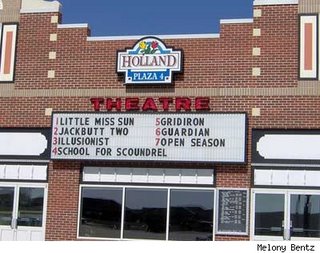 This movie theatre is in Orange City, Iowa, where I used to go to basketball camp as a kid. I think changing the title to "JackButt" might draw more attention to the movie!
My wife suggested, "JackBottom" as another alternative.
 This movie theatre is in Orange City, Iowa, where I used to go to basketball camp as a kid. I think changing the title to "JackButt" might draw more attention to the movie!
My wife suggested, "JackBottom" as another alternative.
Friday Slump
I can't find anything in my head or on the internet that I want to blog about today, thus I'll just say this...
Fearing redundancy... Have I mentioned lately that I think the new John Mayer record is unbelievable? After listening to it now for about three weeks, I am pretty convinced that he is a genius. To musically and poetically write the things that he does puts him in the category of "once in a lifetime" kind of artist.
Most artists don't get better and better on each subsequent album, and usually the third one is a dud for sure. Not the case with John. He is a true artist's artist and anyone who thinks that he is still just a "Your Body is a Wonderland" teen king is very mistaken. He displays a staggering artistic maturity and I often find myself asking, "What planet is this guy from?" He is certainly a freak of nature.
I have heard some people say that in person he is pretty arrogant. Though probably just rumor, it's hard for someone like him to be humble when you are that talented and you know it. Just buy the record and I'll shut up about it.
Fearing redundancy... Have I mentioned lately that I think the new John Mayer record is unbelievable? After listening to it now for about three weeks, I am pretty convinced that he is a genius. To musically and poetically write the things that he does puts him in the category of "once in a lifetime" kind of artist.
Most artists don't get better and better on each subsequent album, and usually the third one is a dud for sure. Not the case with John. He is a true artist's artist and anyone who thinks that he is still just a "Your Body is a Wonderland" teen king is very mistaken. He displays a staggering artistic maturity and I often find myself asking, "What planet is this guy from?" He is certainly a freak of nature.
I have heard some people say that in person he is pretty arrogant. Though probably just rumor, it's hard for someone like him to be humble when you are that talented and you know it. Just buy the record and I'll shut up about it.
Thursday, October 05, 2006
Amish response to shooting
Here is an amazing article that shows a staggering, Christ-like side of the Amish community. The article states:
In just about any other community, a deadly school shooting would have brought demands from civic leaders for tighter gun laws and better security, and the victims' loved ones would have lashed out at the gunman's family or threatened to sue.
But that's not the Amish way.
In the aftermath of Monday's violence, the Amish have reached out to the family of the gunman, Charles Carl Roberts IV, 32, who committed suicide during the attack in a one-room schoolhouse.
Dwight Lefever, a Roberts family spokesman, said an Amish neighbor comforted the Roberts family hours after the shooting and extended forgiveness to them. Among Roberts' survivors are his wife and three children.
Moore on "Jesus Camp"
Pastor Mark Moore has an interesting article in response to the movie, "Jesus Camp". In it he says:
Yesterday afternoon, I watched the film with a good friend of mine. At the ticket booth the guy was quick to comment on our choice of entertainment for the afternoon and informed us that everyone from a “Baptist Minister” to a group of “homeschoolers” had been to see the movie. We were the only ones in the theater until the last minute when we were joined by a man and woman who talked throughout the movie as if they were at a noisy bar. Their comments ranged from, “Oh you’ve got to be kidding me,” to, “That’s sick!” In between the jeering remarks, the woman continually made noises ranging from uncontrollable laughter to something resembling a cat that had just been backed over in the garage. To be honest with you, I’m sure the cat probably felt better with his recent acquisition of tire imprints than this lady felt with her recent acquisition of image imprints. The images on screen were at times enough to cause nausea in doctors who normally spend their days performing colonoscopies.And...
If I chose to respond to everything I took issue with theologically it would wind up being too much to sort through. My biggest concern as I watched this movie was the lady in the theater and countless others like her throughout America. She, and the man she was with, had just been exposed to a strand of Christianity that is extremely foreign to the New Testament.
Tony's Lunch with Piper
At the DGM National Conference a few days ago, there was a speaker panel with John Piper, Tim Keller, and Mark Driscoll. Justin "Tractor" Trailer was posing the questions and I personally found that one of the most interesting questions was the question he asked Piper about his face to face lunch meeting with Tony Jones, leader of Emergent Village. If you want to listen to the audio you can do so here.
Today, Tony posted his take on his lunch with Dr. Piper. I think it's good to at least listen to what others are saying from both sides (can there really be "sides" when Emergent is so diverse?).
Tony also responded here to what Tim Keller said about Emergent in the same Q and A session.
Today, Tony posted his take on his lunch with Dr. Piper. I think it's good to at least listen to what others are saying from both sides (can there really be "sides" when Emergent is so diverse?).
Tony also responded here to what Tim Keller said about Emergent in the same Q and A session.
Wednesday, October 04, 2006
1615.org - "Bruchko"
This past weekend at our church we had a guest preacher, Matt Ellison (Rob Bell look alike), who is the president of an amazing missions organization called 1615.org (take a second and check it out if your church needs help in the area of missions). He called people to forsake the American dream and to pour our lives out for the sake of The Great Commission.
Along these lines is a book that I read a few years back called, Bruchko. If there is any story of a man who took Matt's message very seriously it would, Bruce Olson, the author of this book. I dare you to buy it and read it. After I read the first chapter I couldn't put it down and had to read the whole thing in one sitting. Here is a description:
What happens when a nineteen-year-old boy leaves home and heads into the jungles to evangelize a murderous tribe of South American Indians? For Bruce Olson it meant capture, disease, terror, loneliness and torture. But what he discovered by trial and error has revolutionized the world of missions. This updated version of Bruchko includes the story of his 1988 kidnapping by communist guerrillas and the ten months of captivity that followed. Bruce Olson's story will amaze you and remind you that simple faith in Christ can make anything possible.
Tuesday, October 03, 2006
Intimacy in Relationships
Here is a great article by Raymond Chang, dealing with the needs for deep relationships. As he says, "Go deep, or go to sleep." In his post from relevantmagazine.com he says:
Although his article is not specifically Christ-centered (see what I wrote about relationships here if you want my take on it) I think we can take seriously what he says in it.
Life is all about the people we know and know us. There is nothing more important than those who will mourn at our funerals and be a significant part of our weddings and be present all the rest of the days of our lives. If you really take some time to think about it, relationships make and break experiences; they enhance our lives and give us a reason to wake up in the morning. Relationships are what life was made for.and
One of the problems that I see today is that people don't have enough deep relationships. Some people have many "friends" or at least people they think are their friends, but often do not attain the highest level of friendship—that being intimate friendship. Many people do the bare minimum in terms of maintaining friendship, often times because they haven't experienced anything else and simply just don't know any better.
Although his article is not specifically Christ-centered (see what I wrote about relationships here if you want my take on it) I think we can take seriously what he says in it.
Monday, October 02, 2006
Switchfoot Fall Tour

Switchfoot has announced tour dates for this fall. Here they are:
Oct 17 Bakersfield, CA Fox Theatre
Oct 18 Los Angeles, CA The Roxy
Oct 19 Sacramento, CA Crest Theatre
Oct 20 Portland, OR Crystal Ballroom
Oct 21 Boise, ID The Big Easy
Oct 23 Denver, CO Ogden Theatre
Oct 25 Chicago, IL Metro Smart Bar
Oct 26 Minneapolis, MN The Quest
Oct 27 Milwaukee, WI The Rave
Oct 28 St. Louis, MO The Pageant
Oct 30 Columbus, OH Newport Music Hall
Nov 1 Holland, MI Hope College
Nov 2 Detroit, MI St. Andrews Hall
Nov 3 Cleveland, OH Agora Theatre
Nov 4 Lancaster, PA Chameleon Club
Nov 5 Scranton, PA Tinks
Nov 7 Norfolk, VA The Norva
Nov 8 New York, NY Irving Plaza
Nov 10 Charlotte, NC Tremont Music Hall
Nov 11 Jacksonville Beach, FL Freebird Live
Nov 12 Ft. Lauderdale, FL Revolution
Nov 13 Lake Buena Vista, FL House Of Blues
Nov 14 Atlanta, GA Roxy
Nov 16 Nashville, TN War Memorial Auditorium
Nov 17 Little Rock, AR The Village
Nov 18 Tulsa, OK Cain's
Nov 20 Albuquerque, NM Sunshine Theatre
Nov 21 Tempe, AZ Marquee Theatre
Nov 22 Las Vegas, NV House Of Blues
The Big Picture Story Bible

In the past when I have attended one of John Piper's conferences I have passionately paroused the theological bookstore hearing the deafening cry of my credit card calling to me to put him to work (credit cards are a thing of the past now... thanks Dave Ramsey). In the past I could easily spend $200 in one weekend on books and preaching CD's. Since I have grown a bit older (and hopefully wiser) the blessing of children has caused me to rethink the finances a bit thus this year the only book I bought was a childrens book. (I have enough books on my office shelf that I have not yet gotten to, or yet internalized the content enough to make a significant difference in my life)
After reading the first three short chapters to my four year old, I am convinced that The Big Picture Story Bible might be one of the best purchases we have ever made for our kids. Chalked full of creative illustrations, pulling no punches, yet tactful in the presentation of hard Bible themes, and telling the stories in accurate, yet simple ways for kids, I have to say I have been seriously impressed with this book. In fact, when I got home from church tonight Taylor soon asked if we could continue our reading from this morning.
I would commend this book to you highly for the teaching of God's word to your little ones.
CJ's Highlights are Mine
I'll let CJ Mahaney's comments from the weekend at the Desiring God National Conference speak for me since his sentiments are very similar to my own feelings about what I remember most. On the T4G blog he says:
As you would expect, the conference was a feast of outstanding preaching; but I want to highlight a few moments that stood out to me. Particularly moving were Don Carson and John Piper’s comments to and care for the pastors of smaller churches during one of the panel sessions. There were two panel sessions that were both effectively led by Justin Taylor. In response to a question from Justin, Don and John wisely seized the opportunity to encourage pastors of smaller churches and those who labor faithfully but seem to see little fruit. Don’s tears as he described his father’s faithful pastoral ministry for decades in a rural setting were deeply moving. You could feel the deep effect of his words and his tears upon the souls of all pastors present, but especially those who are faithfully and heroically serving in obscurity. More importantly, you could feel the pleasure of God.
And one other moment that stood out was John Piper’s opening remarks before his message at the final session. John addressed those present who are a part of the emerging church movement and communicated his fatherly concern for them. Since it is clear (and was made clear throughout the conference) that serious doctrinal deficiencies exist in the emerging church, John wanted to communicate his care for those present with whom we disagree. John didn’t want the conference to simply be a series of critiques. Instead, he wanted to persuade and provide the doctrinal discernment that appears to be absent from this movement. And he wanted them to know how much he loved them—even with all his concerns. Again, I felt the pleasure of God.
Then, before he began his message, John made one more comment regarding observations he had previously shared about Mark Driscoll. Earlier in the conference, at the end of a panel session, John had informed us that he had received much criticism for inviting Mark Driscoll to speak at the conference. He explained why he invited Mark and what he appreciated about Mark’s message. He went on to express a concern he had regarding the content of Mark’s message. Though I would have expressed this concern to Mark privately and personally before expressing it publically, I have no doubt that his motive was to serve Mark and those present at the conference. John's critique and concern was related to Mark’s clever comments about culture throughout his message. After the panel session, someone had approached John and observed that John had a tendency to be similarly clever in his comments about the academic world. So before he preached the final session, John acknowledged the accuracy of this observation and correction and its application to his preaching. It was humble for John to inform us of this private conversation and its corrective content. I believe that long after the messages of this conference are forgotten, John’s compelling example of humility will not be forgotten. It will continue to inspire us all to true greatness—to walk humbly before God and with those we have the privilege to serve. Once again, I felt God’s pleasure.
The New Entertainment
J.R. from the xxxchurch.com blog sadly reports:
Praise be to God that he has provided another way. As with most things in the Christian life, it is not instant gratification driven, but the blessings that come from the fight of waiting are incalculably sweet.
What is the foundation of true intimacy? It is God himself that exists trinitarianly in a loving relationship. Thus those who are created in his image are called to love as the greatest commandment. God first, others second. This spells true intimacy. At an even deeper level, God calls a husband and wife to glorify his relationship to the church through true passionate connection that is physical, emotional, and spiritual. This is true intimacy.
May the people of God display these lives of love to a aching, lonely, and pornography pursuing world to show that there is a better way.
Porn, a 57 billion dollar a year industry worldwide. America takes credit for about 1/3 of that cash. This country is watching a big shift. What once was hidden under your Dad’s mattress and was Americas dirty little secret is now attaching itself to families and the very fabric of our lives. We must bite into the reality it is. New, as of late are the increasing numbers of Porn conventions going on around the globe. Almost every major market in this country in 2006/07 will have a porn convention to meet consumer demand... porn has become the new entertainment.I think what strikes me as most sad about this reality is not the objectification of women, or the damage done to marriages, or the slavery of addiction. As grievously heinous as these things are, what jumps to my attention, as being the most tragic aspect of pornography is the sheer loneliness of it all. Women that are always promising and never truly delivering, always beckoning, but never really allowing one to draw near, always available, but never really there. Oh how many men suffering under the weight of this tail-chasing loneliness, but have never seen that there is another far superior way.
Praise be to God that he has provided another way. As with most things in the Christian life, it is not instant gratification driven, but the blessings that come from the fight of waiting are incalculably sweet.
What is the foundation of true intimacy? It is God himself that exists trinitarianly in a loving relationship. Thus those who are created in his image are called to love as the greatest commandment. God first, others second. This spells true intimacy. At an even deeper level, God calls a husband and wife to glorify his relationship to the church through true passionate connection that is physical, emotional, and spiritual. This is true intimacy.
May the people of God display these lives of love to a aching, lonely, and pornography pursuing world to show that there is a better way.
Subscribe to:
Posts (Atom)