
Wednesday, May 31, 2006
Christian Movies in Hollywood?
Mark D. has an informative post about Hollywood cashing in on the $$$ to be gained from the huge Christian movie going population. After The Passion of the Christ, it's not hard to figure out.

Leading with Complementarianism
Covenant Seminary Church History Prof, Sean Michael Lucas has an interesting post called "Generational Difference and Complementarianism". It's worth the read. (For those of you who don't know what complementarianism is just read a definition here.)
In it he cited a post from Mark Dever. It would be my hope that you read Mark's post first.
After you read both:
My take...
1. Could it be that the older pastors have been around the block so many times that they feel like they are sick of getting beat up over this issue? Doesn't make it right to not fight the fight, but it is understandable how one can get worn down and change emphasis after years of abuse at the hands of those who disagree.
2. The young cats have little or no experience at getting kicked around in the church, so they are more than willing to jump up to the front lines of battle on this issue.
In it he cited a post from Mark Dever. It would be my hope that you read Mark's post first.
After you read both:
My take...
1. Could it be that the older pastors have been around the block so many times that they feel like they are sick of getting beat up over this issue? Doesn't make it right to not fight the fight, but it is understandable how one can get worn down and change emphasis after years of abuse at the hands of those who disagree.
2. The young cats have little or no experience at getting kicked around in the church, so they are more than willing to jump up to the front lines of battle on this issue.
Monday, May 29, 2006

Music Monday -Three Nights on the Town

Recently I finished watching Bruce Hornsby's most recent live DVD, "Three Nights on the Town". Anyone with a basic appreciation for jam bands, amazing piano playing, improvisation, and great songwriting will certainly enjoy this DVD. It is a concert that he performed with his amazing band in 2004 and also along with it is a documentary which shows Bruce's quirky personality. I was greatly inspired as a piano player and I would highly recommend it.
Saturday, May 27, 2006
More T-Shirts
Currently I am playing at Spirit West Coast. In case you didn't already know, Christian music festivals are somewhat of a Mecca for Christian retail. As a follow up to my post about Christian T-Shirts, I wanted to document some of the "best" T-shirts that I have seen during my time here.
They are as follows:
FBI Logo– Firm believer in Christ
MLB Logo – Major League Believer
Sprite Logo – Spirit “I like the Spirit in You”
Chritian Girls Rock
GAP Logo – God answers prayer
Harley Davidson Logo – King of Jesus –David’s Son
Christ Jesus – Superman Logo– Able to heal all who are bound
Jesus Got R Done
Addidas Logo – Addicted to Jesus
Grateful Dead Logo– I’m grateful that Jesus rose from the dead
Fear Factor Logo– Perfect love casts out fear – cheerleader shorts
I’d rather be a prude than have genital warts - (all I can say is, wow)
Virginity Rocks
Abortion is Mean (my comment...isn't this slogan horribly simplistic? Abortion is far more than mean, it's a holocaust on the unborn)
Who’s your Daddy? – John 1:12
Ron Jon logo – John 3:16
They are as follows:
FBI Logo– Firm believer in Christ
MLB Logo – Major League Believer
Sprite Logo – Spirit “I like the Spirit in You”
Chritian Girls Rock
GAP Logo – God answers prayer
Harley Davidson Logo – King of Jesus –David’s Son
Christ Jesus – Superman Logo– Able to heal all who are bound
Jesus Got R Done
Addidas Logo – Addicted to Jesus
Grateful Dead Logo– I’m grateful that Jesus rose from the dead
Fear Factor Logo– Perfect love casts out fear – cheerleader shorts
I’d rather be a prude than have genital warts - (all I can say is, wow)
Virginity Rocks
Abortion is Mean (my comment...isn't this slogan horribly simplistic? Abortion is far more than mean, it's a holocaust on the unborn)
Who’s your Daddy? – John 1:12
Ron Jon logo – John 3:16
CD Review of "Worship God Live"

Recently I cashed in on Bob Kauflin’s offer to give away his church’s new worship CD, “Worship God Live” for free to anyone who would write a review of it on his or her blog. So, here it is!
Let me start off by saying that I have the utmost respect for Bob Kauflin as a worship pastor, writer, and thinker about worship in music as it is expressed in our corporate gatherings of worship. I think in recent years mainly through his blog, Bob has become somewhat of a mentor for many worship leaders all throughout the world who desperately are trying to figure out how to lead their people effectively into an appropriate expression of worship in music to our great God.
Bob and his team need to be commended for their attempt to bring a fresh theological substance to worship music that is wrapped in more of a pop/rock genre. There is a great void of this type of music in our current evangelical ecclesiastical scene. I have long lamented this fact and longed to find and perhaps compose music that would have a deeply historical theological substance but also bring with it a fresh musical expression. I think they have done a great job of celebrating the great truths of the Gospel on this record. What better thing is there to sing about?
I got the sense from this record that there was a real desire to express some type spontaneity that would reflect what one would encounter in an actual service at Covenant Life Church. I think this was achieved and gives this CD a more informal feel to it that is refreshing for the listener. It’s almost as if you can place yourself there as a physically present worshipper at their church.
In terms of critique, this is very challenging pursuit since by it’s nature music is subjective. It’s kind of like trying to describe beauty. It’s better to point to what it is rather than try and describe it. Which is more powerful, to try and describe an amazing sunset, or take the person to it and say, “Look at that!” As a songwriter I often times find myself frustrated when I turn in a song to my publisher and it is rejected based on their subjective feelings. There is always the attempt to give concrete things to focus on, but in the end it does not satisfy. There are no formulas for songwriting, or for what makes a great song. There are general tenancies and themes, but at the end of the day all the rules can be broken at times and you are better off just pointing to what is a great song is and say, “Shoot for that. If you miss just keep writing.”
My following critique will be just that, mine. It’s my opinion and an expression of my preferences, thus I offer them humbly not as objective truth but purely as one man’s expression of his subjective opinions.
I think the one thing that stood out to me first was the challenge of expressing these great theological truths in language that poetically fits beautifully and also fits a melody that is equally beautiful and easy to sing. Make no mistake; this is probably the most challenging type of songwriting that I have ever come across. Why is that? Simply because of what I just stated. You have to express deep theology in language that is poetically beautiful, melodically compelling and easy to sing by your average church-goer, and be a song that will please everyone from the kids to the elderly. This is no small task! Their attempt needs to be greatly commended, but in the end I don’t find myself very convinced or coming away from these songs having a huge desire to use them in the church I lead in. Perhaps the exception on the record would be the track, “Jesus, Thank You”. I found that my ears were drawn to that song in a unique way from all the others on the record.
Often times while listening, I felt that Bible truth was expressed in language lyrically and melodically that just didn’t really fit. Great Bible truth to be sure, but clothed in weak melodies and poetry. I say this in comparison to many worship songs out there today that I would consider to be stronger. Again, just my opinion, I have no ill will towards Bob and Covenant Life Church. These are just my honest feelings. I probably feel the need to express these disclaimers since I know that my words could be construed as being mean-spirited. That is definitely not my intent. And as a songwriter I also personally know the pain of critique, which can sometimes leave you feeling attacked and worthless.
My other main critique would be that it predominately sounds too (words will fail here) "chipper", or "sing-songy". I think it might be the male and female unison vocals that to me give it more of a “boomer” sound. Reminded me of my past years going to Willow Creek church conferences when they would have a big vocal team up front singing, with “big” vocals. I think this type of thing may translate better live, but through the recorded medium of a CD it stylistically seems a bit weak. I’m sure this is an opinion that simply stems from a generational tendency and nothing more. I would be curious to know the average age of those who composed all of these songs. I could be wrong, but I would be willing to bet it would be over 40. Newer or younger does not equate to better, I am not saying that at all. I’m just saying that it sounds like a record that has predominately been composed and led by those in the 35-50 age range. Again, this does not make it bad, it just represents a general leaning in style that some will find attractive and others not.
The highlights of this CD for me would probably be the songs, “Jesus, Thank You”, “Grace Unmeasured” and “Surrender All”.
In the end, I greatly appreciate this CD from a theological perspective and for their attempt to tackle the most challenging form of songwriting that there is, but if I heard it playing a Christian bookstore I doubt I would be compelled to buy it.
Friday, May 26, 2006
Timeless Music and CCM
Recently I was mulling over in my mind some of the pop music’s timeless records. Records like, Led Zeppelin’s Four, U2’s Joshua Tree, Michael Jackson’s Thriller, Nirvana’s Nevermind, Radiohead’s OK Computer, not to mention numerous records from The Beatles, and the list goes on and on.
What makes these records timeless? Why are they still cool and fresh sounding ever after all these years? There are many reasons that one could mention as what factors into a “timeless” record, but I would primarily chalk it up to one thing: pure authenticity. These artists were putting forth a pure expression of who they were at the time. They weren’t looking around and asking, “Gee, what is working right now from a marketing perspective that we can cash in on?” Generally speaking I would be willing to bet they were simply taking a risk in terms of being themselves and committing to a recorded medium those artistic leanings that stirred them in the most honest way possible. For everyone one of these bands that do this and have astronomical success there are hundreds of bands that try to be true to themselves and fail miserably since their authentic statement is not something that anyone really wants to listen to. It’s a harsh reality, but from my perspective I think it’s worth the risk.
This has led me to wonder, why are there no “timeless” records in Christian music? I have been racking my brain and trying to come up with a record or two that one could maybe put in the same category. Amy Grant’s, Lead Me On? Maybe. DC Talk’s, Jesus Freak? Maybe. Whiteheart’s, Freedom? Maybe. A Keith Green record or two? He comes close. Rich Mullins? Maybe closer. From my perspective that is really all I can come up with and I’m still not that convinced that those records should be seen in the same light. Actually, as I am writing this I know I am not convinced. They definitely should not be seen in the same light.
Is it because Christian’s just aren’t as talented or gifted of songwriters and musicians as pagan people working in the same realm? I think Phil Keagy would have something to say about that. That answer clearly does not work.
Maybe it’s because Christian music just hasn’t been given enough time to develop. Pop/rock music has been around basically in full form since the early 60’s and Christian music probably dates back to the early 70’s. So I don’t think those 10 years or so is that great of an excuse. Perhaps time will tell if some of these Christian records can reach the “timeless” status. Though personally speaking, I doubt it.
I would submit that the reason Christian music has yet to churn out a “timeless” record is due to the fact that primarily speaking Christian music intentionally does what I was talking about above and attempts to cash in on what is “hot” in the current mainstream musical market place. Thus the artist’s never have the chance spread their wings creatively and are always forced to have whatever will “work” and is immediately seen as marketable and profit making. This is primarily the reason we don’t have any trend setting Christian acts. We are always forced to respond to those trends, not set them. To be sure, there is a missional purpose behind this. It’s great for youth pastor to be able to tell his kids that the new Pillar record sounds a lot like P.O.D. And for this reason as a parent I’m glad that Christian music exists. But at the end of the day I think I would rather have my kids listen to mainstream music that really communicates an authentic and pure musical message than have them listen to music that consistently borrows from the mainstream culture to try and make Jesus cool. As of now this method has yet to produce anything with any real staying power.
In defense of the record companies, they are not big enough in terms of their capital and the Christian buyers market is so small that it can hardly financially sustain a risk-taking and purely authentic artistic statement. This is sad since I’m sure that many Christian musicians are dying to have this type of outlet.
One possible solution…We need a couple of Christian billionaires who are completely sold out to Christian music and can bankroll all the creative authentic artistic expression that talented Christian musicians can come up with. If this were to happen I think it would be a great step in the right direction.
If you are a Christian and you burn stacks of twenties in fireplace during the cold winter months just because you can, then give me a call. I’ve got a record company I want to start.
What makes these records timeless? Why are they still cool and fresh sounding ever after all these years? There are many reasons that one could mention as what factors into a “timeless” record, but I would primarily chalk it up to one thing: pure authenticity. These artists were putting forth a pure expression of who they were at the time. They weren’t looking around and asking, “Gee, what is working right now from a marketing perspective that we can cash in on?” Generally speaking I would be willing to bet they were simply taking a risk in terms of being themselves and committing to a recorded medium those artistic leanings that stirred them in the most honest way possible. For everyone one of these bands that do this and have astronomical success there are hundreds of bands that try to be true to themselves and fail miserably since their authentic statement is not something that anyone really wants to listen to. It’s a harsh reality, but from my perspective I think it’s worth the risk.
This has led me to wonder, why are there no “timeless” records in Christian music? I have been racking my brain and trying to come up with a record or two that one could maybe put in the same category. Amy Grant’s, Lead Me On? Maybe. DC Talk’s, Jesus Freak? Maybe. Whiteheart’s, Freedom? Maybe. A Keith Green record or two? He comes close. Rich Mullins? Maybe closer. From my perspective that is really all I can come up with and I’m still not that convinced that those records should be seen in the same light. Actually, as I am writing this I know I am not convinced. They definitely should not be seen in the same light.
Is it because Christian’s just aren’t as talented or gifted of songwriters and musicians as pagan people working in the same realm? I think Phil Keagy would have something to say about that. That answer clearly does not work.
Maybe it’s because Christian music just hasn’t been given enough time to develop. Pop/rock music has been around basically in full form since the early 60’s and Christian music probably dates back to the early 70’s. So I don’t think those 10 years or so is that great of an excuse. Perhaps time will tell if some of these Christian records can reach the “timeless” status. Though personally speaking, I doubt it.
I would submit that the reason Christian music has yet to churn out a “timeless” record is due to the fact that primarily speaking Christian music intentionally does what I was talking about above and attempts to cash in on what is “hot” in the current mainstream musical market place. Thus the artist’s never have the chance spread their wings creatively and are always forced to have whatever will “work” and is immediately seen as marketable and profit making. This is primarily the reason we don’t have any trend setting Christian acts. We are always forced to respond to those trends, not set them. To be sure, there is a missional purpose behind this. It’s great for youth pastor to be able to tell his kids that the new Pillar record sounds a lot like P.O.D. And for this reason as a parent I’m glad that Christian music exists. But at the end of the day I think I would rather have my kids listen to mainstream music that really communicates an authentic and pure musical message than have them listen to music that consistently borrows from the mainstream culture to try and make Jesus cool. As of now this method has yet to produce anything with any real staying power.
In defense of the record companies, they are not big enough in terms of their capital and the Christian buyers market is so small that it can hardly financially sustain a risk-taking and purely authentic artistic statement. This is sad since I’m sure that many Christian musicians are dying to have this type of outlet.
One possible solution…We need a couple of Christian billionaires who are completely sold out to Christian music and can bankroll all the creative authentic artistic expression that talented Christian musicians can come up with. If this were to happen I think it would be a great step in the right direction.
If you are a Christian and you burn stacks of twenties in fireplace during the cold winter months just because you can, then give me a call. I’ve got a record company I want to start.
Doctrinal Statements
Dan Kimball asks some important questions concerning our systems of belief. I have often asked some of the same questions myself. I think it would be wise to consider his post.
Thursday, May 25, 2006
Leeland

Recently a friend told me about this new band, Leeland, that I HAD to check out. I did. I think they rock. Sounds like a very cool new Christian band. They don't have a CD out yet, but you can hear their tracks on their myspace.com page. I think their debut full length record is due out this summer sometime. They are making the rounds on this summer's Christian festival scene so check out their schedule to see if they are coming near you. Here is a brief bio:
At the age of 11, lead singer Leeland Mooring wrote his first song, Shine, and so the story of the band Leeland began to evolve. A fervent young singer/songwriter/worship leader, Leeland experienced the calling for his life when he was just a kid living in Baytown, TX, traveling with his very musical family in full time ministry. Leading praise and worship with his siblings on a regular basis was the foundation that helped to prepare him with a radical heart for keeping worship original, dynamic, and most importantly, genuine.
In 2000, his family stopped traveling full time and moved back to Baytown, TX. to pastor a church. Around this time they entered Leeland in a talent search offered by Embassy Music in Nashville, where he was a finalist in both the songwriting and artist division. Leelands promising songwriting ability led Embassy to bring him back to Nashville for a workshop where he met with EMI/CMP representative, Kent Coley. Since that time, EMI/CMP has represented him as a songwriter and Kent Coley came on board as manager.
As a natural extension of his songwriting and family collaboration, the band Leeland began to form, made up of his brother Jack Mooring (keyboards/vox), cousin Jake Holtz (bass), and friends Jeremiah Wood (lead guitar) and Mike Smith (drums). After the formation of one cohesive unit, the band began to write new songs, attracting labels in Nashville and eventually materializing into a full recording contract with Provident/Song BMG. Provident/Sony BMG is home to artists such as Jars of Clay, Third Day, Bebo Norman, Michael W. Smith and many more.
As they embark in this beginning stage of their career, the band Leeland is honored and humbled to step up to be a light to their peers and lead them into a worship experience that is not only new and refreshing but that will edify and uplift them. The sounds of European-rock bands such as Coldplay, Delirious, Elbow and U2 are favorites of the band because of the emotional layers involved in their music. Leelands music exemplifies the exciting elements of alternative rock as they seek to dive in and match heart changing lyrics with soaring anthems of majestic melodies. They are currently in the studio recording their debut full-length album which is scheduled to be released in summer of 2006. Please sign-up for our e-mail newsletter to stay updated on album and tour news.
Wednesday, May 24, 2006
Death By Ministry
Some staggering stats, tell-tale signs and great solutions offered by Mark Driscoll concerning pastors and burn-out. I found this article extremely helpful.
The Finest of Christian Marketing
I can't decide if this is a great idea or one that makes me want to barf.
Common Grace and the Arts
Recently I was challenged to watch the movie Brokeback Mountain by a friend who is gay and wanted to give me insight into the plight of those with different sexual leanings. I won't really comment on the movie here (I'm still thinking about it) but after watching it and thinking about it, my attention was drawn to a conversation I had here in the comments section of Challies.com. People were weighing in on what they thought of the movie Crash. It seemed to me that at times, Christians have to completely write off a certain movie or a musical artist with just a blanket statement of "that trash" or "I don't need to fill my mind with that garbage" because it seems like the holy thing to do. Perhaps they want to maintain the appearance of purity by giving blanket statements of condemnation concerning those things that are “worldly”.
I know for sure that this is the response of most Christians when it comes to the movie, Brokeback Mountain. Now to be sure, there is a lot of this is movie that is trash and really doesn't need to be see by anyone who is pursuing Christ as the center of his or her lives. But make no mistake, this movie got serious nods from the Academy, not because they have some liberal political agenda on gay marriage, but simply because in many ways this is an amazing movie. The acting is brilliant, the script is extremely believable and well written, the cinematography is breath-taking, and the story holds your attention for the whole two hours of the film.
Is it ok to acknowledge that a pagan movie has some redeeming qualities? But is it not possible to see God’s common grace in all things that are creative and artistic, Christian or non-Christian? In some ways I really appreciate the music of Kanye West and Eminem. They are amazingly creative and know how to create music that moves people in powerful ways. They have been gifted in ways that most people will find extremely foreign. Unfortunately, they are choosing to use this gifting in ways that completely dishonor their creator, but at least I can celebrate that his image is still dimly relfected and value in an artistic sense what they can do. Do I meditate on it very often? No. Would I let my three year old listen to it? Not when he is three, but maybe when he is 18 and we can have a conversation about these things.
Some would say that I shouldn’t have seen the movie Brokeback Mountain in the first place. Maybe so, but for the sake of the relationship with my friend I took that risk and I think it was worth it, even though it's probably not something that I would watch again.
Would it not be more winsome to an unbelieving world if we were able to indentify and celebrate openly those things that are beautiful and lovely and reflect the image of our creator in the arts, while at the same time speaking candidly about those things that are not in accord with his Word? To look at a movie like Crash or Brokeback Mountain or any other artistic expression that does not wholely honor God and just simply say, “that’s trash” seems to me to be overly simplistic and lacking in grace. I think we can do better than that.
I would love your thoughts.
I know for sure that this is the response of most Christians when it comes to the movie, Brokeback Mountain. Now to be sure, there is a lot of this is movie that is trash and really doesn't need to be see by anyone who is pursuing Christ as the center of his or her lives. But make no mistake, this movie got serious nods from the Academy, not because they have some liberal political agenda on gay marriage, but simply because in many ways this is an amazing movie. The acting is brilliant, the script is extremely believable and well written, the cinematography is breath-taking, and the story holds your attention for the whole two hours of the film.
Is it ok to acknowledge that a pagan movie has some redeeming qualities? But is it not possible to see God’s common grace in all things that are creative and artistic, Christian or non-Christian? In some ways I really appreciate the music of Kanye West and Eminem. They are amazingly creative and know how to create music that moves people in powerful ways. They have been gifted in ways that most people will find extremely foreign. Unfortunately, they are choosing to use this gifting in ways that completely dishonor their creator, but at least I can celebrate that his image is still dimly relfected and value in an artistic sense what they can do. Do I meditate on it very often? No. Would I let my three year old listen to it? Not when he is three, but maybe when he is 18 and we can have a conversation about these things.
Some would say that I shouldn’t have seen the movie Brokeback Mountain in the first place. Maybe so, but for the sake of the relationship with my friend I took that risk and I think it was worth it, even though it's probably not something that I would watch again.
Would it not be more winsome to an unbelieving world if we were able to indentify and celebrate openly those things that are beautiful and lovely and reflect the image of our creator in the arts, while at the same time speaking candidly about those things that are not in accord with his Word? To look at a movie like Crash or Brokeback Mountain or any other artistic expression that does not wholely honor God and just simply say, “that’s trash” seems to me to be overly simplistic and lacking in grace. I think we can do better than that.
I would love your thoughts.
Monday, May 22, 2006
10 Ways to Hinder Your Church
Great post here from a new friend, Doug Eaton. I firmly believe that the Church is the hope of the world. If all of us in the church would take this list seriously, it would greatly impact the effectiveness of the gospel to reach the communities were we live. I was personally convicted by many things found on the list. I would commend it to you highly!
I would personally add at#11: Spend more time arguing about personal stylistic preferences in music than you do discussing how to rightly handle the Word, and #12: Always have a critique, but never offer a helpful solution.
I would personally add at#11: Spend more time arguing about personal stylistic preferences in music than you do discussing how to rightly handle the Word, and #12: Always have a critique, but never offer a helpful solution.
Sunday, May 21, 2006
“Christian” T-Shirts
 When you play in a Christian band you have the distinct privilege of experiencing one of the finest slices of what Christian culture has to offer: Christian music festivals. The season of festivals is almost upon us, thus I have been reflecting upon it today.
 Most of these events are distinctly defined by the following: Desperately hot and humid summer days baking in the sun watching your favorite artists, bumping into sweaty junior high kids who haven’t showered in three days that smell like an onion patch, and waking up at 6:30am because your tent has already heated up to 95 degrees by that time of day. Beyond all of these great elements for the attendees, one of the highlights of the summer festival scene for me as sideman in Matthew West's band is the sampling of amazing Christian T-shirts. You have your classic one’s like, God’s Gym (Gold’s Gym), A Bread Crumb and Fish (Abercrombie and Fitch), and the list goes painfully on and on.
I was at the Nashville zoo yesterday with my family when I was visually assaulted with what I deem to the “best” of all the Christian T-shirts I have ever seen. It is the one that reads, “I am the Christian the Devil warned you about!” I think my good buddy, Eric James Hansen summed it up best concerning this type of apparel when he said the following, “The only thing those T-shirts accomplish is non-verbally saying to an unbelieving world, ‘I’m a Christian and YOUR NOT.’”
Now I’m sure that the man at the zoo wearing this shirt has a profound affection for Jesus, he probably serves wholeheartedly at his church and sacrificially loves his family as any man of God should, but I have to rhetorically ask, if the Great Commission should be one of the main filters though which we look at the world, how does that T-shirt effectively make it through? Does a dying, and unbelieving world look at that slogan and say to themselves, “Wow, that whole Jesus thing seems like something I really want to get on board with!”
I would suggest that it does the exact opposite. It goes well with a church marquee recently that I saw not far from my house that read, “How do you like your eternity, smoking or non-smoking?” That's not exactly the winsome approach that I feel the humility of the cross calls us to. The gospel embodies enough offensiveness in itself, it doesn’t need our help in that area.
I’m not trying to be overly harsh or unfairly critical. I know that the spirit of the person who wears this type of shirt usually is one that embodies a genuine passion for the victory found in Christ, but I deeply desire us as believers to examine what we are communicating to those around us who don’t share our worldview.
Probably the worst t-shirt that I have ever seen was the one that read, “Do the Jew”, modeled after the Mountain Dew slogan, “Do the Dew”. This shirt is so over-the-top offensive that it goes beyond the scope of this article to try and articulate. No lie, this shirt exists.
My bandmate and bass player, James Gregory recalled seeing someone once wearing a T-shirt that said, “They will know we are Christian’s by our T-shirts”. Unfortunately at times I think this shirt might be right.
Friday, May 19, 2006
The Christian Music Industry and Fashion

I attended the Dove Awards and was brokenhearted. I saw all these beautiful Christians, wonderful people, with this wonderful, revolutionary message of Jesus, who, instead of saying, “Look, fashion doesn’t matter, hip doesn’t matter,” were saying “World, please accept us, we can be just as hip as you, just as fashionable, only in a religious way.”- Donald Miller, Blue Like Jazz
I think this quote from Donald Miller cuts right to the heart of something I have been thinking about for a long time since being involved in the Christian music industry (CMI).
Does the way that we dress help or hinder the gospel?
One could say that we take the Hudson Taylor approach and dress like the culture that one is trying to reach. So one could say that dressing like the culture shows that we are not some weird cult and bridges a gap of connection that might be there due to misrepresentation by the secular culture or something like that. I get that. The problem with this in Christian music is that in Christian music generally speaking (there are always exceptions), we primarily are not a missional organization (some would argue me on this) but rather a means to encourage the faith of those who are already Christian.
So if the main point of Christian music serves to encourage the believer, why do we need to dress at the height of coolness, as defined by the secular culture? I would submit a few thoughts:
First, like Donald Miller stated above, we are inherently insecure and feel, “less than” in our profession. Due to this underlying lack of confidence which leads to an intense craving for some sort of validation, we strive to emulate what we see as the definition of what is cool (I don’t know anyone who works in Christian music who thinks that mainstream Christian music is the definition of cool. This has to be a sign of something desperately wrong with our industry, I digress, more on that later) and attempt to show that we can be just like them.
Second, we need a means by which we can separate ourselves from those that we minister to. I kind of feels sinfully good to know that you are dressing way cooler than the average person in the church who comes to your show. No one would admit this, but I believe it’s an underlying attitude that we all hold to one degree or another. It serves as a barrier between the artist and “common people”. Again this is the exact model of the secular culture and thus we use it. Part of being “rock and roll” is to look the part. You are defined by the clothes that you wear. Dress for success, baby! Sometimes when approaching someone who is completely armored up in all the most current of rock and roll fashion is creates an intimidation factor. Immediately before even exchanging a brief hello you are forces to wonder, “Gee, this guy/gal really must be cool, I wonder if I can hang with it?” Feelings of insecurity can be sort of a knee jerk for those that the cool Christian artist comes in contact with. I fear that this sort of thing may be a very subtle hindrance to the gospel.
Another problem with high fashion in CMI is that often times it can become exceedingly distracting, if not put in check. I remember seeing Kevin Max as CreationFest in PA about 5 years ago. Kevin is by far one of my favorite vocalist and artist of all time, stemming back to his days as a member of DC Talk. (Please buy his Christmas album, it's amazing) Anyway, he came out for his show dressed in full white face make-up and angel wings. Now does this necessarily mean that he can’t be a witness for the gospel in his show dressed like this? Well, I would have to probably say no, but there sure are some challenges there, with the primary one being that I don’t remember a thing about Jesus from his show, but I sure do remember what he wore on stage. Does music have to give verbal assent to Jesus in order for it to be worthy music? By no means, but at least if you work for a “Christian” record company and are performing at a “Christian” music festival then I think there should be a different standard in terms of the missional goals of your music.
Do I think that all artists in CMI need to wear the typical pastor’s uniform of khakis and a simple cotton button-down? (But wouldn’t it be so cool if there was a band that did and just rocked your face off?) Of course not, but I think that we need to be aware of why we wear the clothes that we do and consider the fact that what we wear may have a negative impact on the gospel and the people we are trying to minister to with it. For sure, this is an issue a lot like money, where there are no clear black and white rules. The only rule being hopefully that the Holy Spirit would rule in our decision making process.
Thursday, May 18, 2006
Quiet Time Guilt
Anyone who deals with legalistic tendancies in their relationship with God (problably most of us) should read this article. It was very encouraging to me. In it author, Greg Johnson, says:
If you think the purpose behind this little tract is to absolve you from the call to pray or the need for Scripture, think again. My purpose is to free you to desire prayer—to desire God. I want you to long for the pure message of the gospel, spelled out on page after page of the Bible, and to find the joyous freedom found in Christ. Prayer is a grace, not a work. It is a confession of our neediness to God, not a proof that our “relationship with God” is going well. If you think that God will not bless you today because you missed your quiet time, this has been for you. If subtle legalism has left you in bondage so that you no longer hunger for God’s word or freely call out to him in prayer, then hear this: God has already chosen you, pronounced you righteous, adopted you into his family, and promised to finish his work in you. Perhaps you have been lied to in the past. Now it is time for the truth to set you free. Free to be needy. Free to fail. Free to approach God without dread. Free to delight in him rather than in your performance.
New MacBooks
New MacBooks are out! Daddy likey. All you PC users need to heed the hilarious Mac commercials that you see all the time and get into one of these. Amazing.
Here are all the reasons you should be a Mac owner.
Here are all the reasons you should be a Mac owner.
Is It Any Wonder?

Keane's new single (iTunes) has just been released. This song rocks. If this is what we can expect from their new album, "Under The Iron Sea" then I am seriously excited about it. You can listen to the whole song on their myspace page.
Wednesday, May 17, 2006
Anyone sick of DaVinci Code yet?
I know, I know, who needs more of the DaVinci Code. But since I haven't blogged on it yet I thought I would put here what I find to the be the best short summary of problems with it from a Christian perspective. It comes from Phil Ryken.
Having sold some 50 million copies, Dan Brown’s novel The Da Vinci Code (New York: Doubleday, 2003) is one of the runaway bestsellers of all time. In all likelihood, the movie based on the book will turn out to be one of the all time biggest blockbusters. What accounts for the extraordinary popularity of these historical fictions?
To begin with, the story itself is an entertaining one, full of suspense and intrigue. Most of the book’s readers have found it to be a real page-turner. Once they get into the story, their inquisitive minds are so eager to break the code that they won’t put it down until the murder mystery is solved. The Da Vinci Code is also popular because it delves into the genius mind and masterpiece work of one of the world’s greatest artists: Leonardo Da Vinci. This gives the story an aura of intellectual importance. Furthermore, the plot revolves around a conspiracy theory, which always provokes people’s curiosity.
Nevertheless, The Da Vinci Code would not have achieved its stunning success unless it also happened to be a sustained and pernicious attack on biblical Christianity. More than the story itself, or its connection to Leonardo, it is the book’s reinterpretation of Jesus Christ and its revision of Christian history that make it so popular. And so dangerously deceptive.
Here is a brief list of claims The Da Vinci Code makes about the Bible, Jesus, and Christianity, followed by a short statement of the truth as it has been revealed by God and always believed by the church:
The Da Vinci Code claims that “the Bible is a product of man, not of God” (p. 231), and that more than 80 legitimate gospels have been left out of the Bible because they have been suppressed by the church. But the only genuine gospels are the ones we have in our Bibles. Matthew, Mark, Luke, and John are not merely the words of men, but the words of God the Holy Spirit (see 2 Pet. 1:21). They also happen to be the only first-century eyewitness accounts that tell the gospel story of the death and resurrection of Jesus Christ. None of the other so-called gospels meet the basic criteria for even being a gospel.
The Da Vinci Code claims that Jesus of Nazareth was regarded as nothing more than a mortal man until the Council of Nicaea in A.D. 325, when he gained his deity in “a relatively close vote” of church leaders (p. 233). In fact, the vote was 316 to 2, which isn’t that close. But more to the point, the biblical gospels proclaim the deity of Jesus Christ on nearly every page. Jesus Christ the Son of God “is the true God and eternal life” (1 John 5:20).
The Da Vinci Code claims that Jesus was married to Mary Magdalene (p. 245), and that the couple had a daughter, even though neither the Bible nor any other ancient document has ever claimed that Jesus was married. The book also claims that the true children of God today are the physical descendants of Jesus and Mary Magdalene, who is herself the Holy Grail (p. 244). But the Bible says that it is only those who believe in Jesus who have the right to be called the children of God (John 1:12).
The Da Vinci Code claims that “almost everything our fathers taught us about Christ is false” (p. 235). To be more specific, Jesus died a normal, natural death and was never raised from the dead. But all the gospels agree that Jesus was crucified, and that he rose again from the dead. This is the very gospel: that Christ died for our sins and was raised on the third day (see 1 Cor. 15:3-4).
What makes The Da Vinci Code especially deceptive is not simply the errors it makes, but also its claim—on the very first page!—that “all descriptions of artwork, architecture, documents, and secret rituals in this novel are accurate.” To be blunt, this claim is outrageously false. The book is riddled with errors—not just biblical and theological ones, although there are plenty of those—but also artistic and historical ones. Dan Brown’s claim of facticity also seems out of place for a work of historical fiction. If the work is intended to be fictional, then why does the author continue to claim that it is factual? We can only conclude that his book’s deceptions are deliberate.
Sadly, these deceptions will be widely believed. With the creative energy of director Ron Howard, the unassuming credibility of actor Tom Hanks, and a budget of more than a hundred million dollars, people undoubtedly will find the movie as believable as the book. What they will believe—unless they are well informed about the history and authority of the Bible and the person and work of Jesus Christ—is that the Bible is a hoax, Christians have suppressed the truth, and Jesus Christ was just another man.
Some Christians are saying that The Da Vinci Code—both the book and the movie—will give Christians a fresh opportunity to share their faith. That may be true in some cases, and we should be ready, as always, to give a reason for the hope that we have in Jesus. But the main effect of the Da Vinci deception will be to spread the kind of spiritual misinformation that destroys people’s souls. My fear is that for years to come, many people will have false ideas about Christianity that come from the falsehoods they have read in Dan Brown’s book and seen in the movie based on it.
The real hoax is The Da Vinci Code itself. The real conspiracy is the devil’s old plot against Jesus Christ as the Son of God and Savior of the world. And the really good story is the one Dan Brown is trying to suppress: the page-turner the Bible tells about the one and only divine Son of God becoming a man, dying on a cross, and rising again with life for the world. You don’t have to be a code-breaker to figure it out, either. You just have to believe the facts that God has put right in his Word for everyone to see.
Nashville and the Challenge of Real Relationships
I have been living and working in Nashville in the Christian Music Industry (CMI) for almost two years now. Through the course of our time here we have made some interesting discoveries concerning the way things work in the South (we are from the Midwest) and more specifically in terms of the CMI in general.
One of the first things that came to my attention is the challenge of true authentic relationships.
By “authenticity” I mean the kind of Biblical relationship where there can be true honesty, real conflict and resolution, challenge, accountability, vulnerability, an owning of and showing of personal weakness, etc. I lament the fact that this type of relationship seems to not be the norm between people working in the CMI.
In a community where everyone is a potential employee, or employer it become very difficult to achieve this type of true authentic community. Why is this? I believe it primarily has to do with the mingling of a highly relational context and a strict business context. In most aspects of the CMI it’s easy to become very informal informal and "friendly" with people, but at the same time, a bottom-line business mentality is firmly in place.
For example, a musician may spend hours and hours on a tour bus traveling the country with a band. This context is great for fostering relationships due to all the free time spent together. But at the end of the day, there is still an "employer/employee" structure in place thus an honesty and realness that is at times not very comfortable, but proves to grow true relationships is often missing. Why? Because there is always the underlying fear that if I show my true colors or speak a word that might be viewed as confrontational or too honest, I could get fired from my job! It’s like we operate under the false assumption of a community of friends, but at the end of the day, it’s all business, thus there is a mixed message in place that everyone comes to terms with.
Lack of realness in relationships is the offspring of the marriage between the informal relational context and the business mentality.
Just like any other job, relationships are the key to success. If people know you and like you then you will most likely be successful in your pursuits. Maintaining relationships is your lifeblood of success in CMI. If you are talented, but even more, if people know you and like you, then they are more likely to refer you to a gig, writing session, or some other opportunity, etc. Thus there seems to be a lot at stake in terms of relationships.
For example, when I signed my songwriting deal, one of the first things that I was told was that success will be partly found in my ability to make relationships with other great writers in town, thus getting them to like me and what I do, so that we can produce great songs that equates to big money. In one sense, if these relationships work, then there is a pretty good chance that my career as a songwriter will be a success.
What this can lead to, for lack of a better term, is a community of serious "butt-kissers" who wallow in surface relationships built on a cheesy, “I need to get paid” mentality, thinking we are really engaged in true relationships but all the while it’s just a faint echo of what true community really is.
This may or may not be something that people are consciously aware of, but I believe that most people abide by this instinctively if they are going to be successful.
One of the great drawbacks that I see in all of this is that there is a great power in a “most honest” ethic in our relationships. We are all sinners and need people in our lives who love us enough to tell us the truth about the things in our lives that we are blinded to. In fact, I think that all believers in Christ should seek out people who they choose to submit to and they ask them to speak into their lives at any time. Anyone who has been married for very long knows this as they are being sanctified through it, or they are being crushed by it cause they are fighting against it. Some of the most life changing times in my life that have proved to grow me into the image of Christ in deeper ways has been when true friends were honest enough with me to speak truth into my life about an area that I needed to work on. The point is this, if a very talented person surrounds himself with people who can easily cash in on their success then this most likely has a much smaller chance of taking place to the great detriment of the growth of that person.
I have another fall-out theory that may or may not be true but I think it might be worth pondering. When I moved to town I was shocked to find so many men in the CMI that were near my age (30) and single. It seems that where I was from this was not the case. It might be just that I am living now in a bigger city and thus there is a bigger population of people of all walks of life, but something just seemed weird about the sheer number of men in the CMI that I keep meeting who were single. This could be due to the fact that guys in CMI are frequently on the road, thus it’s hard to maintain a relationship. This could be one answer.
I am wondering if the deeper reasons lies in what I am talking about here. If you have been raised in this type of community where there is a great hindrance to true authenticity in relationships, then moving to a deep marriage commitment where a true authentic Biblical relationship is mandated for success can prove to be a huge challenge. I can understand why all these guys are still single. The relational context of their career has proved to be a disadvantage to their ability to enter into the relational demands of the marriage covenant.
I could be way off my rocker on this one, but I think it is worth considering.
Everyone wants to see change in the CMI, and I would submit that analyzing and understanding the context of relationships with each other might be a great place to start.
One of the first things that came to my attention is the challenge of true authentic relationships.
By “authenticity” I mean the kind of Biblical relationship where there can be true honesty, real conflict and resolution, challenge, accountability, vulnerability, an owning of and showing of personal weakness, etc. I lament the fact that this type of relationship seems to not be the norm between people working in the CMI.
In a community where everyone is a potential employee, or employer it become very difficult to achieve this type of true authentic community. Why is this? I believe it primarily has to do with the mingling of a highly relational context and a strict business context. In most aspects of the CMI it’s easy to become very informal informal and "friendly" with people, but at the same time, a bottom-line business mentality is firmly in place.
For example, a musician may spend hours and hours on a tour bus traveling the country with a band. This context is great for fostering relationships due to all the free time spent together. But at the end of the day, there is still an "employer/employee" structure in place thus an honesty and realness that is at times not very comfortable, but proves to grow true relationships is often missing. Why? Because there is always the underlying fear that if I show my true colors or speak a word that might be viewed as confrontational or too honest, I could get fired from my job! It’s like we operate under the false assumption of a community of friends, but at the end of the day, it’s all business, thus there is a mixed message in place that everyone comes to terms with.
Lack of realness in relationships is the offspring of the marriage between the informal relational context and the business mentality.
Just like any other job, relationships are the key to success. If people know you and like you then you will most likely be successful in your pursuits. Maintaining relationships is your lifeblood of success in CMI. If you are talented, but even more, if people know you and like you, then they are more likely to refer you to a gig, writing session, or some other opportunity, etc. Thus there seems to be a lot at stake in terms of relationships.
For example, when I signed my songwriting deal, one of the first things that I was told was that success will be partly found in my ability to make relationships with other great writers in town, thus getting them to like me and what I do, so that we can produce great songs that equates to big money. In one sense, if these relationships work, then there is a pretty good chance that my career as a songwriter will be a success.
What this can lead to, for lack of a better term, is a community of serious "butt-kissers" who wallow in surface relationships built on a cheesy, “I need to get paid” mentality, thinking we are really engaged in true relationships but all the while it’s just a faint echo of what true community really is.
This may or may not be something that people are consciously aware of, but I believe that most people abide by this instinctively if they are going to be successful.
One of the great drawbacks that I see in all of this is that there is a great power in a “most honest” ethic in our relationships. We are all sinners and need people in our lives who love us enough to tell us the truth about the things in our lives that we are blinded to. In fact, I think that all believers in Christ should seek out people who they choose to submit to and they ask them to speak into their lives at any time. Anyone who has been married for very long knows this as they are being sanctified through it, or they are being crushed by it cause they are fighting against it. Some of the most life changing times in my life that have proved to grow me into the image of Christ in deeper ways has been when true friends were honest enough with me to speak truth into my life about an area that I needed to work on. The point is this, if a very talented person surrounds himself with people who can easily cash in on their success then this most likely has a much smaller chance of taking place to the great detriment of the growth of that person.
I have another fall-out theory that may or may not be true but I think it might be worth pondering. When I moved to town I was shocked to find so many men in the CMI that were near my age (30) and single. It seems that where I was from this was not the case. It might be just that I am living now in a bigger city and thus there is a bigger population of people of all walks of life, but something just seemed weird about the sheer number of men in the CMI that I keep meeting who were single. This could be due to the fact that guys in CMI are frequently on the road, thus it’s hard to maintain a relationship. This could be one answer.
I am wondering if the deeper reasons lies in what I am talking about here. If you have been raised in this type of community where there is a great hindrance to true authenticity in relationships, then moving to a deep marriage commitment where a true authentic Biblical relationship is mandated for success can prove to be a huge challenge. I can understand why all these guys are still single. The relational context of their career has proved to be a disadvantage to their ability to enter into the relational demands of the marriage covenant.
I could be way off my rocker on this one, but I think it is worth considering.
Everyone wants to see change in the CMI, and I would submit that analyzing and understanding the context of relationships with each other might be a great place to start.
Monday, May 15, 2006
Desiring God Ministries National Conference
Here John Piper is interviewed on the purpose of the conference. Looks like it is going to be a very exciting weekend!
Part 1
Part 2
Part 3
Part 4
(HT: Tractor Trailer Taylor)
Part 1
Part 2
Part 3
Part 4
(HT: Tractor Trailer Taylor)
Music Monday - Keith Jarrett - Koln Concert

Epic solo piano record from the greatest jazz musician alive today.
From allmusic.com...
Recorded in 1975 at the Köln Opera House and released the same year, this disc has, along with its revelatory music, some attendant cultural baggage that is unfair in one sense: Every pot-smoking and dazed and confused college kid -- and a few of the more sophisticated ones in high school -- owned this as one of the truly classic jazz records, along with Bitches Brew, Kind of Blue, Take Five, A Love Supreme, and something by Grover Washington, Jr. Such is cultural miscegenation. It also gets unfairly blamed for creating George Winston, but that's another story. What Keith Jarrett had begun a year before on the Solo Concerts album and brought to such gorgeous flowering here was nothing short of a miracle. With all the tedium surrounding jazz-rock fusion, the complete absence on these shores of neo-trad anything, and the hopelessly angry gyrations of the avant-garde, Jarrett brought quiet and lyricism to revolutionary improvisation. Nothing on this program -- so ideally suited to CD -- was considered before he sat down to play. All of the gestures, intricate droning harmonies, skittering and shimmering melodic lines, and whoops and sighs from the man are spontaneous. Although it was one continuous concert, the piece is divided into four sections, largely because it had to be divided for double LP. But from the moment Jarrett blushes his opening chords and begins meditating on harmonic invention, melodic figure construction, glissando combinations, and occasional ostinato phrasing, music changed. For some listeners it changed forever in that moment. For others it was a momentary flush of excitement, but it was change, something so sorely needed and begged for by the record-buying public. Jarrett's intimate meditation on the inner workings of not only his pianism, but also the instrument itself and the nature of sound and how it stacks up against silence, involved listeners in its search for beauty, truth, and meaning. The concert swings with liberation from cynicism or the need to prove anything to anyone ever again. With this album, Jarrett put himself in his own league, and you can feel the inspiration coming off him in waves. This may have been the album every stoner wanted in his collection "because the chicks dug it." Yet it speaks volumes about a musician and a music that opened up the world of jazz to so many who had been excluded, and offered the possibility -- if only briefly -- of a cultural, aesthetic optimism, no matter how brief that interval actually was. This is a true and lasting masterpiece of melodic, spontaneous composition and improvisation that set the standard.
"I Just Don't Have Time"
There are many times when I am asked to partake in something that I really have no desire for, I quickly revert to the every present trump card of, "Sorry...I just don't have time". Now let's be honest, this is a dishonest statement most of the time. We have all the time in the world! If someone told me that if I drove to California right now to simply pick up a briefcase of $50K in cash, I would easily, "make time" to go and get this done.
I would submit for the sake of greater authenticity in our relationships and for the sake of more genuine honesty in our lives to not use this statement unless we really mean it. Wouldn't it be revolutionary to actually say what we mean with a phrase like, "Sorry, I am just choosing to not make that a priority right now"? I know this may sound extremely arrogant and completely lacking of any refined social grace but isn't it the most honest?
I know that pure honesty always has to be tempered with a healthy dose of discernment and wisdom and at times the phase “I don’t have time” is actually true, but as I ponder this right now I think I would have much greater respect for someone who could look me in the eye and say, “Sorry, that I just not something I can make a priority right now in my life”, than one who basically lies for the sake of softening the blow. In the end, being real with people will bear the most fruit.
Just something to think about…
I would submit for the sake of greater authenticity in our relationships and for the sake of more genuine honesty in our lives to not use this statement unless we really mean it. Wouldn't it be revolutionary to actually say what we mean with a phrase like, "Sorry, I am just choosing to not make that a priority right now"? I know this may sound extremely arrogant and completely lacking of any refined social grace but isn't it the most honest?
I know that pure honesty always has to be tempered with a healthy dose of discernment and wisdom and at times the phase “I don’t have time” is actually true, but as I ponder this right now I think I would have much greater respect for someone who could look me in the eye and say, “Sorry, that I just not something I can make a priority right now in my life”, than one who basically lies for the sake of softening the blow. In the end, being real with people will bear the most fruit.
Just something to think about…
Sunday, May 14, 2006
Saturday, May 13, 2006
"Sex, Drugs and Rock and Roll" won't satisfy?
James Hetfield, front man of Metallica, tells it like it is in this short article. Great to see evidence of grace in this guy.
"Jesus Loves Porn Stars" Bible
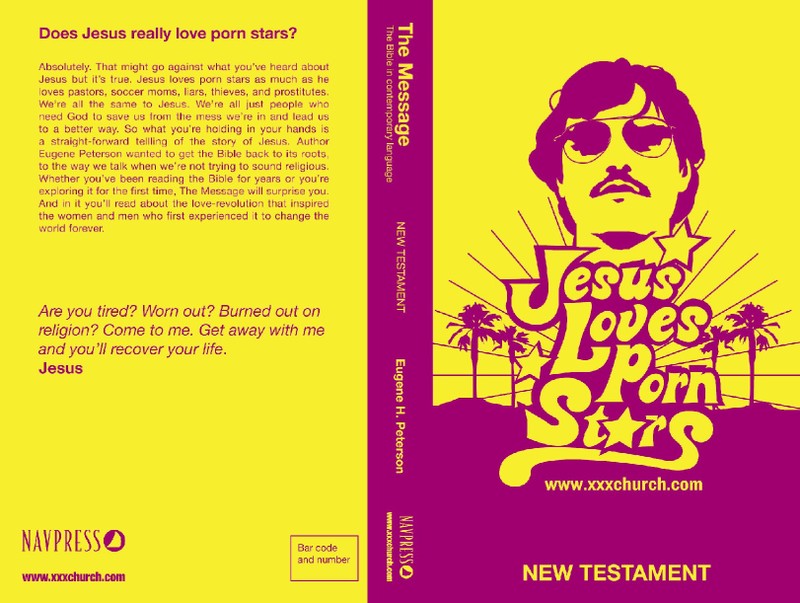
This is a Bible that that guys from xxxchurch.com will take to porn conventions and hand out at their booth to try and spread the gospel in the sick world of the porn industry.
Click on the picture here and read the description on the back of these Bibles.
I totally understand where the xxxchurch.com guys are going with this and I greatly commend their efforts, but theologically speaking I think the note on the back of the Bible is grossly simplistic in terms of how the Bible talks about the love of God. Does God love all people the same? Yes and no. Do I love all people the same? Well yes, in a sense God calls me to that, but do I love my children with a special distinction? Of course. I think the same is true of God. God's saving love only rests on those who put their faith in him. If not, then you are loved in a John 3:16 sense, but at the same time an object of his wrath. Does Jesus love porn stars? Yes! But that is not the end of the story. Maybe the back clip just needs more clarification.
I think I have the most problem with the statement "We're all the same to Jesus". I am afraid this is a great Christian slogan that most of us have come to accept because it gets repeated over and over again in various forms. Again, I think it is important to understand that there is a grave distinction Biblically between those who are "received a spirit of sonship" (Romans 8:15) and those who are under God's wrath (Romans 1:18). This is no means for arrogance (Eph.2:8-10), but only a remembrance of God's sovereign grace and his electing love which can only humble those who embrace it.
Again, I greatly commend xxxchurch.com guys for their efforts in this tragic world of sexual perversion. The church needs much more of this kind of risk-taking passion to creatively take the gospel where it may never be found otherwise.
Thursday, May 11, 2006
American Idol
(Sorry to have a completly insignificant rant here, but I just want to get this off my chest...)
I don't watch much TV, but this year for the first time, I have gotten sucked into American Idol. All I have to say is this... After last night's wack results, does anyone still believe that this whole thing is not fixed? Come on, millions of dollars are a stake and the AI people are not just going to allow the general public to determine this thing. The two "M"'s will always be king and queen - Marketability and Money. It's not hard to figure out. Maybe I've gone off the deep end here as I contemplate my American Idol conspiracy theory, but oh well...
I don't watch much TV, but this year for the first time, I have gotten sucked into American Idol. All I have to say is this... After last night's wack results, does anyone still believe that this whole thing is not fixed? Come on, millions of dollars are a stake and the AI people are not just going to allow the general public to determine this thing. The two "M"'s will always be king and queen - Marketability and Money. It's not hard to figure out. Maybe I've gone off the deep end here as I contemplate my American Idol conspiracy theory, but oh well...
Misquoting Scripture
James 1:2-5 states -
These verses have to do with suffering that leads to greater sanctification on the part of the believer since God’s will is for us is to be “mature and complete” in Him. I had always wondered why then does James in verse 5 make a sharp turn to talking about wisdom?
When trying to solve questions of Biblical interpretation and more specifically, what is meant by a specific word, in this case “wisdom”, it is often times helpful to look throughout the greater context to see how the author defines the word. Key = how does the author define the word, not, how do I define the word.
In chapter 3:13-18 he says -
Here James seems to define “wisdom” in more of a “fruit of the spirit” kind of way. So if we take this definition of wisdom back to our original problem verse in chapter one, it may make more sense.
If in the face of “trials of many kinds” you are a lacking purity, peace, gentleness, mercy, and good fruit, etc, (attributes from chapter 3 passage above) then you can ask God and he will supply the character that you need to endure the trial.
In the past I have used this verse to counsel myself or others to use this verse when wrestling with making a hard decision. Seek God and he will provide the wisdom that you need to make the choice! Now, that admonition is not unbiblical per se, but I think using this verse to affirm that truth may be a bit misdirected based on the context of the verse and the greater context of the book of James that helps us understand what he means by wisdom.
Seems to make sense to me, but I could be wrong here. I would love hear your thoughts.
Consider it pure joy, my brothers, whenever you face trials of many kinds, because you know that the testing of your faith develops perseverance. Perseverance must finish its work so that you may be mature and complete, not lacking anything. If any of you lacks wisdom he should ask God who gives generously to all without finding fault, and it will be given to him (NIV).
These verses have to do with suffering that leads to greater sanctification on the part of the believer since God’s will is for us is to be “mature and complete” in Him. I had always wondered why then does James in verse 5 make a sharp turn to talking about wisdom?
When trying to solve questions of Biblical interpretation and more specifically, what is meant by a specific word, in this case “wisdom”, it is often times helpful to look throughout the greater context to see how the author defines the word. Key = how does the author define the word, not, how do I define the word.
In chapter 3:13-18 he says -
Who is wise and understanding among you? By his good conduct he should show his works done in the gentleness that wisdom brings. But if you have bitter jealousy and selfishness in your hearts, do not boast and tell lies against the truth. Such wisdom does not come from above but is earthly, natural, demonic. For where there is jealousy and selfishness, there is disorder and every evil practice. But the wisdom from above is first pure, then peaceable, gentle, accommodating, full of mercy and good fruit, impartial, and not hypocritical. And the fruit that consists of righteousness is planted in peace among those who make peace.
Here James seems to define “wisdom” in more of a “fruit of the spirit” kind of way. So if we take this definition of wisdom back to our original problem verse in chapter one, it may make more sense.
If in the face of “trials of many kinds” you are a lacking purity, peace, gentleness, mercy, and good fruit, etc, (attributes from chapter 3 passage above) then you can ask God and he will supply the character that you need to endure the trial.
In the past I have used this verse to counsel myself or others to use this verse when wrestling with making a hard decision. Seek God and he will provide the wisdom that you need to make the choice! Now, that admonition is not unbiblical per se, but I think using this verse to affirm that truth may be a bit misdirected based on the context of the verse and the greater context of the book of James that helps us understand what he means by wisdom.
Seems to make sense to me, but I could be wrong here. I would love hear your thoughts.
Ed Stetzer and Missional Theology
Mark Driscoll has an interesting post with author, Ed Stetzer, on missional theology. In it he says:
In this book we recognized that if the Great Commission is to be realized, all people need to hear the gospel and experience church in a language they can understand. In a world where "all nations" can no longer be defined in simply linguistic terms, this is not easy. Since our context is made up of many people groups, population segments, and cultural environments, one size does not fit all—and we want to help churches find their biblical expression in every culture. Read the whole thing Mark Driscoll has an interesting post with author, Ed Stetzer, on missional theology.Read the whole thing here.
Wednesday, May 10, 2006
Quote
"A dead thing can go with the stream, but only a living thing can go against it."
-GK Chesterton
-GK Chesterton
Tuesday, May 09, 2006
Quote of the Day
C.S. Lewis:
Read the whole thing here.
Every age has its own outlook. It is specially good at seeing certain truths and specially liable to make certain mistakes. We all, therefore, need the books that will correct the characteristic mistakes of our own period. And that means the old books. All contemporary writers share to some extent the contemporary outlook—even those, like myself, who seem most opposed to it. Nothing strikes me more when I read the controversies of past ages than the fact that both sides were usually assuming without question a good deal which we should now absolutely deny. They thought that they were as completely opposed as two sides could be, but in fact they were all the time secretly united—united with each other and against earlier and later ages—by a great mass of common assumptions. We may be sure that the characteristic blindness of the twentieth century—the blindness about which posterity will ask, "But how could they have thought that?"—lies where we have never suspected it, and concerns something about which there is untroubled agreement between Hitler and President Roosevelt or between Mr. H. G. Wells and Karl Barth. None of us can fully escape this blindness, but we shall certainly increase it, and weaken our guard against it, if we read only modern books. Where they are true they will give us truths which we half knew already. Where they are false they will aggravate the error with which we are already dangerously ill. The only palliative is to keep the clean sea breeze of the centuries blowing through our minds, and this can be done only by reading old books. Not, of course, that there is any magic about the past. People were no cleverer then than they are now; they made as many mistakes as we. But not the same mistakes. They will not flatter us in the errors we are already committing; and their own errors, being now open and palpable, will not endanger us. Two heads are better than one, not because either is infallible, but because they are unlikely to go wrong in the the same direction. To be sure, the books of the future would be just as good a corrective as the books of the past, but unfortunately we cannot get at them.
Read the whole thing here.
Monday, May 08, 2006
Biology and Homosexuality
New research may point to biological trends in gays and lesbians that are different from heterosexuals.
Pastor John Piper has a helpful word about this here:
Pastor John Piper has a helpful word about this here:
What if there Were Genetic Origins for Sexual Disorder?To read the whole sermon, click here.
This is crucial for dealing with the origins of homosexuality. I don't think anyone knows for sure what the physical components of homosexuality are. But what if genetic origins were found? What would this imply about the morality and fitness of the behavior? Very little, if nature itself is disordered and in need of redemption. So let's look at this matter more closely this morning.
Consider Romans 8:20-23, "The creation was subjected to futility, not willingly, but because of Him who subjected it, in hope." Notice that all of creation has been subjected to futility: things don't work the way they were originally designed to work. Winds, rains, rivers, volcanoes, bacteria, viruses, Swiss Air jet electrical wiring, brake linings, heart-attacks of 86-year-old men driving through a crosswalk while a blind student crosses the street, wild white blood cells, trisomy of the 21st chromosome, and ten-thousand heartaches from a fallen world - the creation was subjected to futility.
By whom? Verse 20 says, "By Him who subjected it in hope." That's not man and not Satan, but God. God subjected the world to futility "in hope." All the futility of this world is meant to waken us to the horrors of exchanging the glory of God for other things and to make us rely not on ourselves, but on God who raises the dead (2 Corinthians 1:8-9) and restores the glory (Romans 8:18-19).
Keep reading. Verses 21-22: ". . . that the creation itself also will be set free from its slavery to corruption (= futility) into the freedom of the glory of the children of God. For we know that the whole creation groans and suffers the pains of childbirth together until now." Paul pictures the miseries and futilities and pains of creation as childbirth before the resurrection when all the pain of our disordered bodies and sexuality will be replaced with glory of God among his people.
And Paul even addresses the crying question that we raised last week: But surely, if all this misery and disorder and dysfunction in the world is owing to God's judgment - his handing us over to the outworking of our ungodliness -then would he not lift the misery and the disorder and the dysfunction and the pain from his children who repent and believe the gospel? He gives his answer in verse 23: "And not only this [that is, not only does the "whole creation groan"] but also we ourselves, having the first fruits of the Spirit, even we ourselves groan within ourselves, waiting eagerly for adoption as sons, the redemption of our body."
The answer is: No, God does not deliver his people all at once from the futility of this fallen, judged creation. He turns the effects of judgment into the means of grace for his people (Romans 8:28). And he saves us in stages. "Having been justified by his blood, much more shall we be saved" (Romans 5: 9-10). We have forgiveness for sin now; we will have freedom from all sinning later. We have reconciliation with God now; we will have complete intimacy later. We have the firstfruits and the downpayment of the Holy Spirit now; we will have the full harvest of his power and presence later. We have some healing now (from our sexual disorders!); we will have full wholeness later. We see his beauty through a glass darkly now, later we will see face to face. We have peace with God now; we will have perfection later. That's the meaning of Romans 8:23.
What is "Natural"? The point of all this is that, whatever the physical or social or personal origins of the homosexual disordering of our sexuality, none of that would define it as good or "natural" or "normal." In a world where God is the Creator and Designer of life, "natural" means in sync with God's purpose and design, not just anything that has physical causes. Having a physical root makes nothing right. Physically-based, aggressive tendencies may lead to violent behavior, but we don't condone it. Physically-based lethargic tendencies may lead to laziness and neglect, but we don't condone it. Frenetic tendencies may lead to disruption and workaholism. A gloomy bent may lead to suicidal thoughts. An anxious bent may lead to paranoia. Addictive tendencies may lead to alcoholism or bondage to gambling or deadly smoking. A low frustration threshold may lead to outbursts of rage. Strong sexual desires may lead to lust or pornography or fornication or adultery or polygamy.
In other words, in a world where the effect of sin permeates to the roots of nature and disorders all of life, we cannot define as good and natural whatever has physical roots. There must be a higher norm than fallen nature. There are many physically-based abnormalities in the world. Therefore having a physical base or root is not sufficient reason for condoning anything as natural or good.
John Owen and JT
For those of you who don't know about John Owen, (he was coined by my church history professor as "The Jonathan Edwards of England") his book, "Of the Mortification of Sin in Believers" (1656)is deemed by most evangelicals as one of the most important theological and pastoral works of the last 500 years. My former roomate, Justin "Tractor Trailer" Taylor, just co-edited a new book that is a reworking of Owen's historic three volume work. The Crossway website describes the book as follows:
John Owen's three classic works on sin and temptation are profoundly helpful to any believer who seeks to become more like Jesus Christ. In this volume, the editors have made Owen's language more accessible without sacrificing any of his wonderful content. It is a uniquely accessible edition of John Owen's previously daunting work.To pre-order this book you can click here.
Music Monday - J.S. Bach

There is a reason the music of J.S. Bach has been around for more than 400 years. Simply because it is pure genius. I have been getting into my roots of classic music a bit more these days for the sake of broadening my musical language and deepening my technical ability. Recently I purchased Bach's "Well Tempered Clavier" which is seen as one of the greatest classical works in all of musical history. In this collection of songs, Bach wrote a prelude in all 12 keys, major and minor and a fugue in all 12 keys, major and minor . 48 songs totaling in all. The version I now own in performed by Keith Jarrett (more on him some other time) and is utterly amazing. I would highly recommend it to all whole appreciate the foundations of western music as we know it today.
To read a great summary of Bach's life and work, click here.
To purchase The Well Tempered Clavier you can find it here (iTunes) or here (Amazon).
A New Emphasis in Critique
What is the proper means of critiquing someone else’s beliefs? Recently I have been pondering this issue as I have been engaged in some interesting conversations on blogs , through reading and listening to lectures. One of my biggest concerns has to do with what logicians and philosophers call “The Straw Man Argument”. Wikipedia defines it as follows:
I see this happening all the time when the person who if being critiqued is not able to respond in “real time”. The typical way this is played out in a scholarly ways is that the one person with a certain set of beliefs will write a book that outlines his position and then someone who holds a different position will respond critiquing that position. This can be seen all over evangelicalism with debates concerning Open Theism vs. Orthodox Reformed Theology or Calvinism and Arminianism, etc. A great example can be found in Norman Geisler’s “Chosen But Free” and then the response of James R. White with “The Potter’s Freedom”. This issue is not new to the life of the church and all the great debates throughout the course of church history usually were structured in this way all the way from Augustine and Pelagius through Luther and Erasmus.
My great draw back with this structure for critique is that there is no place for person-to- person response and listening. It is too easy (whether intentional or not) to set up a “straw man” argument or over simplify and misrepresent a belief that one holds so that it seems very black and white when the incorrect belief is crushed. For example, one author may say, “My difference with person x has to do with his belief that…” then goes to articulate his take on the beliefs of the person he is critiquing. He may or may not be correct in his articulation of the other person’s belief.
Thus I would suggest that for greater health in this sort of thing that we attempt to move toward “real time” critique, that is not necessarily a debate structure, (although it could easily turn into that) but a means by which a real conversation would take place with give and take and clarification and correction with an audience listening in to judge for themselves what they take to be of value and what should be discarded.
This fall I am looking forward to hopefully attending the Desiring God Ministries national conference (watch the trailer here) which will no doubt deal with the issue of the Emergent Church. On the roster of speakers there is not one person who is in favor theologically with the positions of the Emergent church. I am totally fine with this, because I am not a big fan of their theology, but wouldn’t there be a great strength in inviting one of these guys to carefully articulate what it is that they really believe and then watch them interact with a D.A. Carson or a John Piper? I think is would be wonderfully more powerful than simply having D.A. or Pastor John give us quick sound bites on what it is they believe and then critique it or warn us of the dangers from there.
Another strength of this position is that it enables a relationship between persons to take place. Writing books, or blogs, or emails back and forth is very impersonal and I feel it is much easier to the “ethic of love” shine through in face-to-face contact and could decrease much of the feelings of personal attack that can creep in though the written forms.
Some might say that this is not very practical. Why not? If one has time to write a whole book about a person’s beliefs, why couldn’t they hold a public conversation that deals with the issues? At least in Christian circles I would hope that we could move toward more of this type of thing.
Thoughts?
A straw man argument is a rhetorical technique based on misrepresentation of an opponent's position. To "set up a straw man" or "set up a straw-man argument" is to create a position that is easy to refute, then attribute that position to the opponent. A straw-man argument can be a successful rhetorical technique (that is, it may succeed in persuading people) but it is in fact misleading, since the argument actually presented by the opponent has not been refuted.
I see this happening all the time when the person who if being critiqued is not able to respond in “real time”. The typical way this is played out in a scholarly ways is that the one person with a certain set of beliefs will write a book that outlines his position and then someone who holds a different position will respond critiquing that position. This can be seen all over evangelicalism with debates concerning Open Theism vs. Orthodox Reformed Theology or Calvinism and Arminianism, etc. A great example can be found in Norman Geisler’s “Chosen But Free” and then the response of James R. White with “The Potter’s Freedom”. This issue is not new to the life of the church and all the great debates throughout the course of church history usually were structured in this way all the way from Augustine and Pelagius through Luther and Erasmus.
My great draw back with this structure for critique is that there is no place for person-to- person response and listening. It is too easy (whether intentional or not) to set up a “straw man” argument or over simplify and misrepresent a belief that one holds so that it seems very black and white when the incorrect belief is crushed. For example, one author may say, “My difference with person x has to do with his belief that…” then goes to articulate his take on the beliefs of the person he is critiquing. He may or may not be correct in his articulation of the other person’s belief.
Thus I would suggest that for greater health in this sort of thing that we attempt to move toward “real time” critique, that is not necessarily a debate structure, (although it could easily turn into that) but a means by which a real conversation would take place with give and take and clarification and correction with an audience listening in to judge for themselves what they take to be of value and what should be discarded.
This fall I am looking forward to hopefully attending the Desiring God Ministries national conference (watch the trailer here) which will no doubt deal with the issue of the Emergent Church. On the roster of speakers there is not one person who is in favor theologically with the positions of the Emergent church. I am totally fine with this, because I am not a big fan of their theology, but wouldn’t there be a great strength in inviting one of these guys to carefully articulate what it is that they really believe and then watch them interact with a D.A. Carson or a John Piper? I think is would be wonderfully more powerful than simply having D.A. or Pastor John give us quick sound bites on what it is they believe and then critique it or warn us of the dangers from there.
Another strength of this position is that it enables a relationship between persons to take place. Writing books, or blogs, or emails back and forth is very impersonal and I feel it is much easier to the “ethic of love” shine through in face-to-face contact and could decrease much of the feelings of personal attack that can creep in though the written forms.
Some might say that this is not very practical. Why not? If one has time to write a whole book about a person’s beliefs, why couldn’t they hold a public conversation that deals with the issues? At least in Christian circles I would hope that we could move toward more of this type of thing.
Thoughts?
Saturday, May 06, 2006
Divorce and Remarriage - an angle I had not considered
This morning I was reading in Mark 10 where Jesus was talking about divorce. It brought to a mind a recent podcast (iTunes) that I listened to from str.org’s Greg Koukl. A caller was questioning what the Bible really taught about divorce and remarriage and Greg said the usual things on the topic of divorce concerning adultery and desertion. He followed this with another angle that I had never heard of before that may be a bit controversial, but I think is well worthy of reflection.
He asked the caller, “Does the Bible tell us it’s ok to lie?” – answer –“NO”
“Does the Bible ever tell us to lie?” – answer – “NO”
“Are there times in the Bible when lying is the right thing to do?” answer – “Yes”
The classic example of this is the story of Rahab and the spies found in Joshua, chapter 2. Greg went on to explain that there are moral absolutes in the Bible, but those absolutes are graded.
Some are more important than others. At times we are put in a position where we have to choose one or the other. For example, tell a lie, or allow Joshua to be captured and killed.
The Bible is not explicit about circumstances where divorce may fall into this sort of category, but it seems to be implicit that there will be moral dilemmas at which point you will be obligated to do the lesser evil.
For example, the Bible does not say that it is ok to get a divorce if the father is committing physical abuse upon the wife or the children to the point of murder, but is it not implicit there that the greater of the two evils is murder and not divorce? Choosing divorce over murder seems to be more moral choice in this instance.
Some may say that this leads us down the path of a slippery slope and that divorce is never an option (excluding the above exceptions), but separation is what we should embrace instead. I agree that adding this line of thinking to the conversation about divorce and remarriage may lead to come very challenging sets of circumstances, but at least we need to consider this third option carefully and Biblically as we attempt to discern God’s will for his people.
He asked the caller, “Does the Bible tell us it’s ok to lie?” – answer –“NO”
“Does the Bible ever tell us to lie?” – answer – “NO”
“Are there times in the Bible when lying is the right thing to do?” answer – “Yes”
The classic example of this is the story of Rahab and the spies found in Joshua, chapter 2. Greg went on to explain that there are moral absolutes in the Bible, but those absolutes are graded.
Some are more important than others. At times we are put in a position where we have to choose one or the other. For example, tell a lie, or allow Joshua to be captured and killed.
The Bible is not explicit about circumstances where divorce may fall into this sort of category, but it seems to be implicit that there will be moral dilemmas at which point you will be obligated to do the lesser evil.
For example, the Bible does not say that it is ok to get a divorce if the father is committing physical abuse upon the wife or the children to the point of murder, but is it not implicit there that the greater of the two evils is murder and not divorce? Choosing divorce over murder seems to be more moral choice in this instance.
Some may say that this leads us down the path of a slippery slope and that divorce is never an option (excluding the above exceptions), but separation is what we should embrace instead. I agree that adding this line of thinking to the conversation about divorce and remarriage may lead to come very challenging sets of circumstances, but at least we need to consider this third option carefully and Biblically as we attempt to discern God’s will for his people.
Friday, May 05, 2006
A blog conversation about movies.
Tim Challies as Challies.com posted this today:
One commenter said this:
Another responded with this:
I responded with this:
Interesting comments. There is so much here to comment on:
1. Tim, is there a useful difference between saying the "f-word" was used 100 times and actually using it? When one puts down "f-word" or writes f#$% we all know what that word is and it probably is running through our mind as we read. In light of the Jesus' teaching about adultery/lust, etc in the Sermon on the Mount isn't this just about the same thing? Does that make sense? I just think we all can kind of ride the line of hypocrisy or legalism with that. This may be a petty point, but I think it is worth thinking through. To sum up, if we are so against the "f-word" then don't put "f-word" anywhere on the page cause it just brings it to mind.
2. In terms of Phil 4:8 - I wholeheartedly believe that we are to meditate on what is good and right and pure, but if that means that we can't go to a rated R movies then I think we may be approaching legalism again. My main problem with it is that then one could really never read the OT since the OT has so much graphic violence and graphic sex (see Song of Solomon) that one would have too avoid it completely. Now I understand that a majority of the time the sex and violence put out by Hollywood is generally set up in a way as to arouse lust, so great caution must be exercised. To be fair, there have been many rated R movies that I have seen were I walked away wondering, "was there any redeeming value in that whatsoever? I should have spent that 2 hours reading a book or playing music or something..." Again, great caution should be the norm.
3. I fear that there is an almost greater danger on the flip side of the freedom that I may be advocating here. John Piper has helped me see in some of his preaching and writing that true spiritually for Christians runs far deeper than not going to rated R movies, not swearing, not cheating on your taxes and not getting drunk and not having premarital sex. The problem is that we can avoid all those sinful trappings and still go to hell if we don't have a right heart. The "avoidance ethic" is what he calls it. One defines their relationship to God based on all those things they avoid, as opposed to cherishing Christ for who he is.
4. Does using the (sorry to be hypocritical here) "F-word" make a movie all bad? I think Crash was an amazing movie. I don't think it's really necessary to swear all the time, but the fact that it was there didn't hinder my ability to walk away thinking about God's desire for us to have real relationships that have substance and really examining my own prejudices, etc. There has to be some sort of middle ground. To say, any hint of swearing and sex disqualifies a movie from being labeled as good for Christians. We need more careful qualification I think.
5. I would submit that Cinderella Man was the best movie of 2005 and on my list of best of all time. I’m not sure if I have ever seen a movie that so inspired me to love and fight for my family more than this one. If that is not on God’s agenda for me as a father and husband, then I don’t know what is.
Friday Ramblings
I noticed a few days ago that Christianity Today has listed their "10 Most Redeeming Films of 2005." "What do we mean by "redeeming" films? They're all stories of redemption--sometimes blatantly, sometimes less so. Several of them literally have a character that represents a redeemer. And with some of them, the redemption thread is buried beneath the surface; you might have to look a bit harder for it, but it's most certainly there. Some of them are 'feel-good' movies that leave a smile on your face; some might leave you with more of a contemplative frown, asking, 'How should I process that?'"
Here is the list of films:
Cinderella Man
Batman Begins
Murderball
Crash
The Exorcism of Emily Rose
Munich
Dear Frankie
Pride & Prejudice
The Lion, The Witch and The Wardrobe
Millions
Of those I have only seen the last three. Pride & Prejudice and The Lion, The Witch and The Wardrobe were both excellent. Millions was awful. I was disappointed to see a movie like Crash make it to the list. Now I have not seen the film, but judging by what I know of it, I wouldn't even if I wanted to. It is rated R and apparently for good reason. The following warning is provided by PluggedIn Online: "THIS FILM FEATURES GRAPHIC VIOLENCE AND LEWD SEXUAL CONTENT. THIS REVIEW REFERENCES THAT CONTENT AND IS NOT APPROPRIATE FOR CHILDREN." The review mentions that there is intense, explicit wildly inappropriate sexual content, plenty of brutal violence and a lot of bad language. "Like the rapid-fire shots of a drive-by, the f-word is sprayed about 100 times (several times it's used with “motherâ€; it's also used in a sexual manner). The s-word is said at least a dozen times, while God’s name is misused almost as frequently and is often combined with “d--n.†Christ’s name gets abused four times. More than 30 other milder profanities further mar this film, including several sexual slang terms."
But I'm sure it's a wonderful tale of redemption. Maybe I'll rent it tonight and watch it with the kids so we can all be blessed together. Or not. Every now and then I'm tempted to wonder if Christianity Today can stoop any lower. And yet somehow they always manage.
One commenter said this:
"Crash" was very thought-provoking. Not an easy film to see (or hear, as you pointed out) and certainly not family fare. Not even a typical Hollywood film. I was surprised when it won the Academy Award. But better "Crash" than that other travesty...
Another responded with this:
To anyone else:
How do we really apply Philippians 4:8 to the movies? What does "think on or meditate on" in that passage apply to?
I KNOW I will probably get blasted for sounding holier than thou, BUT please understand I am not being judgmental (SINCE I DON'T KNOW ANY OF YOU). I really just want an honest answer...please!
In Christ,
Greg
I responded with this:
Interesting comments. There is so much here to comment on:
1. Tim, is there a useful difference between saying the "f-word" was used 100 times and actually using it? When one puts down "f-word" or writes f#$% we all know what that word is and it probably is running through our mind as we read. In light of the Jesus' teaching about adultery/lust, etc in the Sermon on the Mount isn't this just about the same thing? Does that make sense? I just think we all can kind of ride the line of hypocrisy or legalism with that. This may be a petty point, but I think it is worth thinking through. To sum up, if we are so against the "f-word" then don't put "f-word" anywhere on the page cause it just brings it to mind.
2. In terms of Phil 4:8 - I wholeheartedly believe that we are to meditate on what is good and right and pure, but if that means that we can't go to a rated R movies then I think we may be approaching legalism again. My main problem with it is that then one could really never read the OT since the OT has so much graphic violence and graphic sex (see Song of Solomon) that one would have too avoid it completely. Now I understand that a majority of the time the sex and violence put out by Hollywood is generally set up in a way as to arouse lust, so great caution must be exercised. To be fair, there have been many rated R movies that I have seen were I walked away wondering, "was there any redeeming value in that whatsoever? I should have spent that 2 hours reading a book or playing music or something..." Again, great caution should be the norm.
3. I fear that there is an almost greater danger on the flip side of the freedom that I may be advocating here. John Piper has helped me see in some of his preaching and writing that true spiritually for Christians runs far deeper than not going to rated R movies, not swearing, not cheating on your taxes and not getting drunk and not having premarital sex. The problem is that we can avoid all those sinful trappings and still go to hell if we don't have a right heart. The "avoidance ethic" is what he calls it. One defines their relationship to God based on all those things they avoid, as opposed to cherishing Christ for who he is.
4. Does using the (sorry to be hypocritical here) "F-word" make a movie all bad? I think Crash was an amazing movie. I don't think it's really necessary to swear all the time, but the fact that it was there didn't hinder my ability to walk away thinking about God's desire for us to have real relationships that have substance and really examining my own prejudices, etc. There has to be some sort of middle ground. To say, any hint of swearing and sex disqualifies a movie from being labeled as good for Christians. We need more careful qualification I think.
5. I would submit that Cinderella Man was the best movie of 2005 and on my list of best of all time. I’m not sure if I have ever seen a movie that so inspired me to love and fight for my family more than this one. If that is not on God’s agenda for me as a father and husband, then I don’t know what is.
Media Overload
Big Mike pointed me to a great article from Joshua Harris. Really hit me between the eyes as one who is addicted to his laptop!
MuteMath on TV
Probably one of the world's coolest bands is MuteMath. They also happen to be Christians. If you want to watch them perform my three-year-old's favorite song, "Choas" on the Late Late show with Craig Ferguson you can do so by clicking here (Quicktime).
To view the behind the scenes footage from this performance click here.
To view the behind the scenes footage from this performance click here.
Jesus at the movies
Interesting article here from yahoo.com about the rise of faith-based themes in movies coming out from Hollywood. 370 million dollars from The Passion of the Christ isn't a hard figure out
from a business perspective. Is the rise of more "christian" movies a good or bad thing? Could go either way in my opinion, but that's a conversation for a later day.
Excerpt:
from a business perspective. Is the rise of more "christian" movies a good or bad thing? Could go either way in my opinion, but that's a conversation for a later day.
Excerpt:
Long criticized by conservative Christians for profiting from violent or sexually graphic films that corrupt the young, Hollywood is starting to see there is money to be made catering to those critics.
"On Sunday, 43 percent of America was in church," Jonathan Bock, head of a movie marketing company that specializes in religious audiences, said at a panel discussion on "What Would Jesus Direct?" at the Tribeca Film Festival this week.
"For studios to not recognize that's an audience is like them saying, 'We're not marketing movies to men,"' Bock said.
Is even repentance a gift?
This morning I was reading in 1 Samuel concerning the priest Eli and his sons, Hophni and Phinehas. His sons were evil and forsook God's commands concerning the sacrifice and did other things in the sight of the Lord that caused him to be angry. Eli, their father was reasoning with them to repent from their wicked ways and then this verse struck me ... 1 Sam. 2:25b - "But they would not listen to the voice of their father, for it was the will of the Lord to put them to death."
Can it be that God is sovereign even over our acts of repentance? I believe this verse shows that he is. There is one word in that verse that kept echoing in my mind after I read it and it was the word, “for”. This word points to the reason why they would not listen to their father’s pleas to repent. They would not listen, FOR (or because)…
Another verse in the Bible that points to this same truth is 2 Tim. 2:24 -“And Gods servant must not quarrel; instead he must be kind to everyone, able to teach, not resentful. Those who oppose him he must gently instruct in the hope that God would GRANT them repentance leading to a knowledge of the truth.”
Does this seem unfair? Should we not be able to be completely free in ourselves to respond to God as we should? If God has to grant us repentance how can he then hold us accountable? Paul in Romans 9 asks a similar question from an assumed objector and says to him, “One of you will say to me: "Then why does God still blame us? For who resists his will?" But who are you, O man, to talk back to God? Shall what is formed say to him who formed it, 'Why did you make me like this?' "Does not the potter have the right to make out of the same lump of clay some pottery for noble purposes and some for common use?”
I know that here I am reaching into the depths of over 2000 years of theological reflection, but all this to say that 1 Sam. 2:25 was a new verse to me that seems to affirm certain theological convictions that I find true in other parts of the Bible.
For more along these lines you can find a great article here.
Can it be that God is sovereign even over our acts of repentance? I believe this verse shows that he is. There is one word in that verse that kept echoing in my mind after I read it and it was the word, “for”. This word points to the reason why they would not listen to their father’s pleas to repent. They would not listen, FOR (or because)…
Another verse in the Bible that points to this same truth is 2 Tim. 2:24 -“And Gods servant must not quarrel; instead he must be kind to everyone, able to teach, not resentful. Those who oppose him he must gently instruct in the hope that God would GRANT them repentance leading to a knowledge of the truth.”
Does this seem unfair? Should we not be able to be completely free in ourselves to respond to God as we should? If God has to grant us repentance how can he then hold us accountable? Paul in Romans 9 asks a similar question from an assumed objector and says to him, “One of you will say to me: "Then why does God still blame us? For who resists his will?" But who are you, O man, to talk back to God? Shall what is formed say to him who formed it, 'Why did you make me like this?' "Does not the potter have the right to make out of the same lump of clay some pottery for noble purposes and some for common use?”
I know that here I am reaching into the depths of over 2000 years of theological reflection, but all this to say that 1 Sam. 2:25 was a new verse to me that seems to affirm certain theological convictions that I find true in other parts of the Bible.
For more along these lines you can find a great article here.
Thursday, May 04, 2006
The Importance of Music
This article from Relevant Magazine is a good reminder. Although I'm not sure that I agree with everything in it, I think it raises some good issues to think about. Primarily, does music created by musicians that profess no faith in God, still bring glory to God? I would say yes, if by glory we mean the reflection of God's own creativity that shines brightly in all forms of human creativity whether that reflection is recognized or not.
Wednesday, May 03, 2006
Elwood Taylor
My grandfather, Elwood Taylor, passed away a few days ago. He was 88 and died of a stroke that struck him suddenly and rendered him brain dead for a few days until they removed the respirator and he passed in 30 minutes. He was married to his wife Margret for 64 years. I have many fond memories of my grandpa, Elwood.
1. He was always deaf as a rock, so you had to shout anything for him to hear you. The only person who he could really understand was his wife, Maggie and her shrill voice always cut through to his comprehension.
2. His always asking me, "Ya got some hair on your chest yet?", and "Are you going to keep her?" (in reference to my wife Kim)
3. He would always make up random songs about the Lord and "sing" them (I use the word sing here very loosely) to all who would listen. I think this was his form of preaching.
4. He never was one for much sublty or social grace in his statements, but he was such a nice man that we never held this against him. Some of the classics were: Frequently asking my sister Annelie if "she was keeping her weight down", and calling us grand kids "a bunch of wild indians".
5. Elwood spent years milking cows and as a result he had very strong hands. For as long as I can remember, up to the point when he died, he would come up to me or my sister and place his mammoth hand on the place right above your knee where it's really sensitive and squeeze. It was always just to the point of playful uncomfortablility, but I always had the sense that he could have crushed my leg if he had wanted to. These huge hands also made him a backrub favorite for my wife Kim and my sister Annelie.
6. He was very good at remembering dates. He always knew everyone's birthday and the year we were born. He would always tell you how old you were.
7. He loved to go to McDonald's. All that he wanted for Christmas or his birthday was a gift certificate to McDonalds. He would say, "That's the best place to go"
8. He was an avid golfer and played without a cart up until a couple years ago. I remember playing with him a few years back at a small par three course in Cedar Falls, IA (where I am from) and he dominated me. He couldn't hit it far, but straight as an arrow.
9. He was a very healthy man. He was never on any form of regular medication. When he was younger he used to do 30 push-ups everyday.
10. He would always grab my arm and inspect my bicep and then say "OOOOOOOH, strong!"
1. He was always deaf as a rock, so you had to shout anything for him to hear you. The only person who he could really understand was his wife, Maggie and her shrill voice always cut through to his comprehension.
2. His always asking me, "Ya got some hair on your chest yet?", and "Are you going to keep her?" (in reference to my wife Kim)
3. He would always make up random songs about the Lord and "sing" them (I use the word sing here very loosely) to all who would listen. I think this was his form of preaching.
4. He never was one for much sublty or social grace in his statements, but he was such a nice man that we never held this against him. Some of the classics were: Frequently asking my sister Annelie if "she was keeping her weight down", and calling us grand kids "a bunch of wild indians".
5. Elwood spent years milking cows and as a result he had very strong hands. For as long as I can remember, up to the point when he died, he would come up to me or my sister and place his mammoth hand on the place right above your knee where it's really sensitive and squeeze. It was always just to the point of playful uncomfortablility, but I always had the sense that he could have crushed my leg if he had wanted to. These huge hands also made him a backrub favorite for my wife Kim and my sister Annelie.
6. He was very good at remembering dates. He always knew everyone's birthday and the year we were born. He would always tell you how old you were.
7. He loved to go to McDonald's. All that he wanted for Christmas or his birthday was a gift certificate to McDonalds. He would say, "That's the best place to go"
8. He was an avid golfer and played without a cart up until a couple years ago. I remember playing with him a few years back at a small par three course in Cedar Falls, IA (where I am from) and he dominated me. He couldn't hit it far, but straight as an arrow.
9. He was a very healthy man. He was never on any form of regular medication. When he was younger he used to do 30 push-ups everyday.
10. He would always grab my arm and inspect my bicep and then say "OOOOOOOH, strong!"
The Blogging Church
A good word about church and blogs. Author Andrew Odom says,
Read the whole thing here.
As I see it, the advent of the blog was not intended to become a replacement for anything pre-existing. It was, rather, a way of enhancing communication on a broader scale. It was a way to share pictures of the new apartment, send shout-outs to your friends half a world away and let people know about the band you heard last night. Somewhere along the journey the blog seemed to morph.
Read the whole thing here.
Tuesday, May 02, 2006
Bush and Bush
For those of you who have not yet seen Bush and his evil twin, you can watch it here. It's actually pretty funny. It's great to see that the president has the ability to poke fun at himself.
Monday, May 01, 2006
Music Monday - Willy Porter

Ever have one of those experiences when you don’t know whether you are going to laugh or cry because of something you are experiencing is so intensely beautiful? It’s like all five of your senses are on overdrive and you have no desire to downshift. That is how I describe my first time seeing Willy Porter in concert. Just him and a guitar for 2 and a half hours of pure musical ecstasy.
Willy is one of the most amazing acoustic guitar players you will ever run across. Willy is a true artist, yet his music is very accessible, groove oriented and soulful. If you ever get the chance to see him play live, all I can say is, GO! He will blow you away. I have seen him probably 5 or 6 times live and I would say that by far he shines the brightest when he is all alone with his guitar. His band is cool, but sometimes his guitar virtuosity gets lost in the band.
He has released five CD’s to date and I think my favorite is "Falling Forward". His live disc where he plays solo is also a must have.
One of the greatest things about Willy is that you really get the sense that he is one of the nicest guys you would ever meet. Every time I have seen him play he has expressed a genuine respect for his audience and for the fact that we would come and hear him play his songs. He drops the occasional “F-bomb” so you might not want to bring the kids, but don’t let that hold you back from seeing his show.
One of the most impressive things that he does in his show is that he usually randomly asks the audience for three different totally random topics and then he writes a song about those things on the spot. For example, "A Big Wheel", "Acne", and "Green Beans". Usually it's about the funniest thing you have ever heard.
Here is his website for more info.
Subscribe to:
Posts (Atom)